

When you lay a Kapetto rug in your home, you are inviting in something more than fine fiber and careful craft. You are inviting in a story — specifically, the stories of the women rug weavers who gave that piece its shape, its color, and its quiet soul. In Bhadohi, the ancient carpet capital of northern India, women have been central to the weaving tradition for generations. Today, at Kapetto's partner workshops, they are not just contributors. They are masters.
These are five of them. Their names deserve to be spoken alongside the rugs they make.
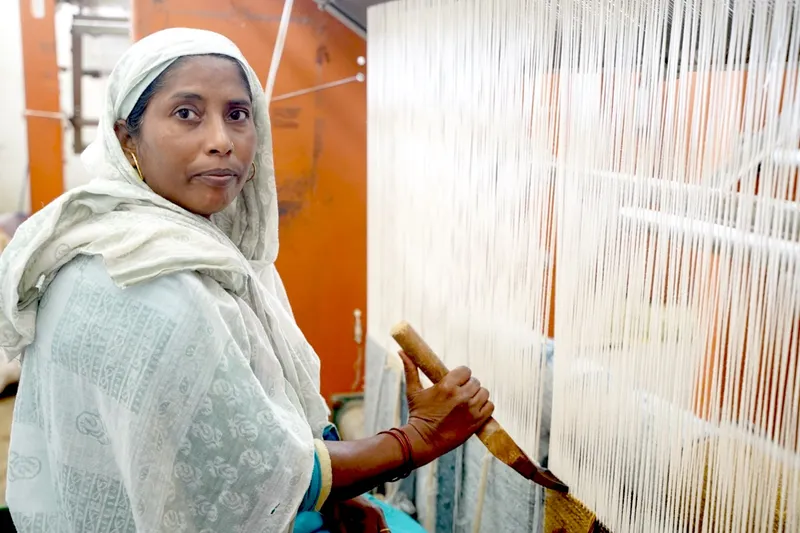
Rubina Bano: The Quiet Precision of Cashmere
Rubina Bano learned to weave at her mother's knee when she was eleven years old. By the time she was twenty, other weavers were watching her hands. Rubina specializes in cashmere — a fiber so fine it demands a level of consistency that most artisan rug makers India takes years to develop. A cashmere yarn can be as little as 15 to 18 microns in diameter, barely thicker than a strand of human hair, and any variation in tension shows immediately in the finished pile.
Rubina's knotting rhythm is described by the workshop supervisor as metronome-like. Over an eight-hour shift she ties between 10,000 and 12,000 individual knots, each one placed with the same pressure as the last. The result is a pile surface of extraordinary evenness — something you feel the moment your hand passes over it. That smoothness is not an accident. It is Rubina, repeated over weeks.
She works primarily on Kapetto's Cashmere Collection, including the Cashmere Caramel. The 15mm pile height that defines these rugs requires both depth of knotting and a precise finishing cut — both of which Rubina oversees herself from loom to shearing table.
"When the cashmere is right, you don't just see it. You feel it before you touch it. There is something in the surface that tells you."
— Rubina Bano, master weaver
Ayesha Ansari: Color, Memory, and the Dye Bath
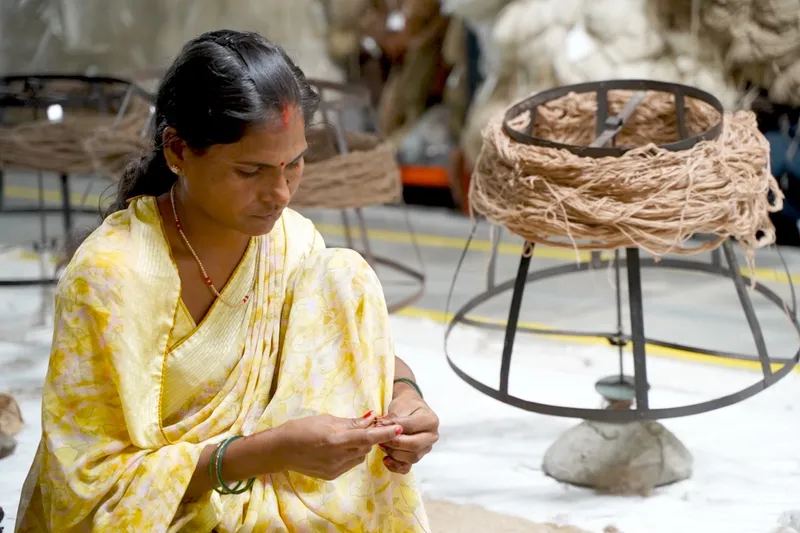
Ayesha Ansari is not just a weaver. She is Kapetto's lead colorist at the Bhadohi workshop — the person who oversees the transition from raw fiber to the warm, layered palette that distinguishes every piece in the collection. Her expertise bridges two disciplines: the chemistry of natural dye processes and the intuitive eye needed to evaluate color in finished pile.
Natural dyeing is an inexact science by design. The same mordant applied to the same fiber at different humidity levels or water temperatures will yield subtly different results. Ayesha has spent fifteen years learning to read these variables — to know when a madder-dyed skein has reached the warm terracotta she is after, or when an indigo bath needs another hour before the blue deepens into the right register.
Her color memory is considered remarkable. Workshop colleagues describe her ability to match a reference swatch from memory after examining it only briefly. For custom Kapetto commissions, where a client needs a precise color matched to an existing interior, Ayesha's eye is the final authority.
She weaves as well as she dyes. On the loom, Ayesha tends toward the hand-knotted constructions of the Kiri Collection, where the tighter weave allows the chromatic subtlety of her dye work to express itself fully.
Kavita Sharma: Structure, Geometry, and the Warp
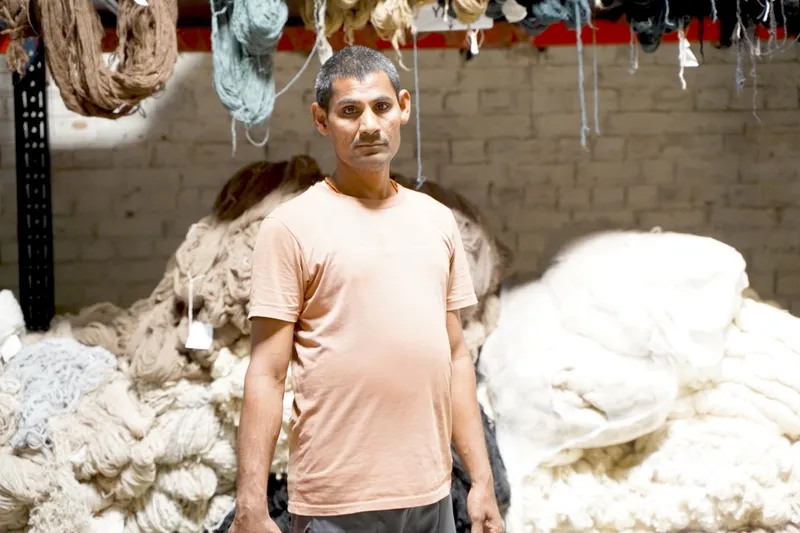
Before a single knot is tied in a Kapetto rug, weeks of preparation happen at the loom — the warping, the tension calibration, the pattern mapping. Kavita Sharma is the artisan rug maker India who does this foundational work for the workshop's most demanding commissions. Her domain is structure, and she approaches it with an engineer's rigor.
Warping a loom for a complex geometric design requires counting hundreds of individual threads and placing them at precise intervals across a frame that may be eight feet wide. A single miscount will throw the entire pattern off-center — an error that only becomes visible hours or days later, when the pattern has already been established in the knotted pile. Kavita has not made that error in many years.
She is also skilled in what the workshop calls "design reading" — the ability to interpret a paper cartoon (the scaled pattern drawing used as the weaver's guide) and translate it directly into structural decisions at the warp. For organic, flowing motifs, this is an interpretive act as much as a technical one.
Kavita has been at the workshop for twelve years. She trains new weavers in loom preparation, passing on a body of knowledge that is not written anywhere but lives in her hands and in the hands of those she teaches. Learn more about the craft traditions she represents at The Craft.
Nafisa Begum: Finishing and the Feel of the Final Rug
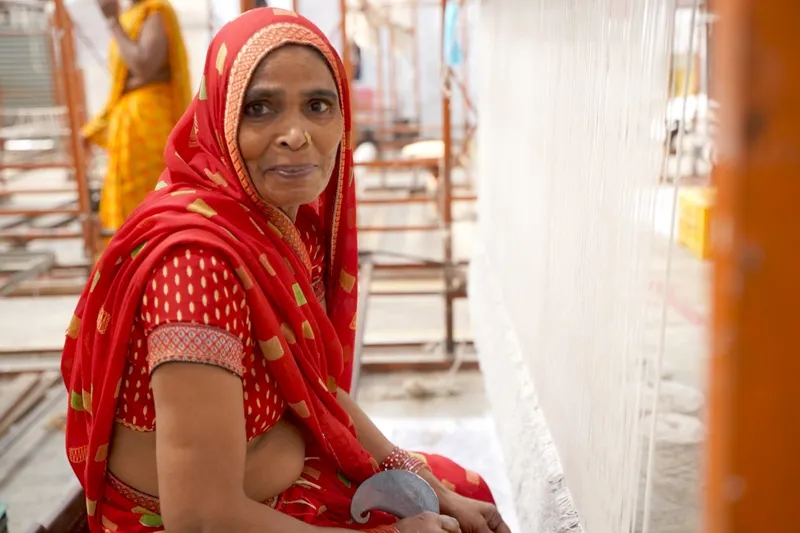
The moment a hand-knotted rug is cut from the loom, it is transformed — from a textile in process to a finished object. But it is not yet complete. The pile must be sheared to a consistent height, the fringe trimmed or secured, the surface washed and blocked to set its final dimensions. These steps, collectively called finishing, are where a rug's character is fully revealed. Nafisa Begum is Kapetto's finishing lead.
Nafisa works with a large pair of curved shearing scissors — a tool that takes years to master — and a practiced eye for evenness. She is the last person to judge the pile height of every Kapetto cashmere rug before it is packaged, ensuring that the 15mm depth specified in the design brief is met across the entire surface. Where the pile is uneven, she corrects. Where a fiber sits incorrectly, she draws it into alignment.
The washing and blocking process falls under her supervision as well. A handmade rug that has been woven under tension will relax slightly when the warp is cut — the pile opens, the colors brighten, and the piece gains the subtle undulation that distinguishes it from anything machine-made. Nafisa reads these changes and adjusts the blocking accordingly so that the final dimensions are within specification.
"Finishing is not the end," she says. "It is when the rug becomes itself."
Nargis Khatoon: Teaching and the Future of the Craft
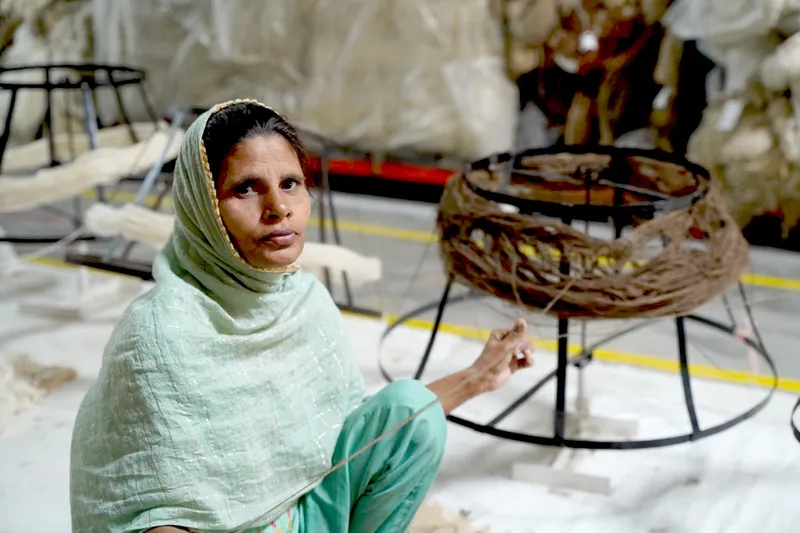
Every craft tradition that survives does so because someone chose to teach it. In Bhadohi's weaving community, Nargis Khatoon is that person. With twenty-three years at the loom behind her, she now spends a significant portion of her time in the workshop's training room, working with new recruits — most of them young women from surrounding villages who have never held a knotting tool before.
The training program Nargis runs is structured over six months. New weavers begin on sample frames, learning the Persian knot and the correct knotting rhythm before they progress to production looms. Nargis is patient but precise. She will stop a trainee mid-knot to correct a tension problem, but she frames the correction as a question rather than a judgment. "What do you feel in your fingers?" she asks. "Is it the same as last time?" The goal is not compliance. It is internalized skill.
For Nargis, teaching weaving to women is inseparable from a broader conviction about economic independence. A skilled weaver in Bhadohi can earn a reliable income without leaving her community. The work can be done in partnership with family life. And mastery brings status — not just income. Women rug weavers who reach senior levels in the workshop are recognized as authorities, consulted by newer artisans and by the design team alike.
"When a woman learns this work well," Nargis says, "it belongs to her. No one can take it away."
Weaving as Empowerment: The Broader Picture
The stories of Rubina, Ayesha, Kavita, Nafisa, and Nargis are individual, but they reflect a pattern that runs through Bhadohi's weaving culture — one that Kapetto is actively committed to strengthening. Women make up the majority of the skilled workforce at Kapetto's partner workshops, and the brand's sourcing practices are designed to ensure that this remains true and that those women are compensated fairly for their expertise.
Fair wages are the foundation. But Kapetto's commitment to the women in its supply chain goes further. The workshops provide safe working conditions, flexible hours that accommodate family responsibilities, and access to the training programs that allow women to develop toward senior skill levels and supervisory roles. Gender equity in craft is not a side initiative. It is built into how Kapetto sources every piece it sells.
The Sustainability page outlines the certifications and labor standards that formalize these commitments, including GoodWeave certification, which specifically addresses fair labor practices and child labor prevention in the rug industry.
For interior designers and architects who care about the provenance of what they specify, knowing the names of the people who made a rug matters. Kapetto believes it matters enough to tell you. Explore the full roster of Kapetto artisans, or discover the collections these women help create: the Cashmere Collection and the hand-knotted Wool Collection. The Trade program offers designers direct access to extended information on provenance, construction, and custom capabilities.


