

Hospitality rug specification is a different discipline from residential work. The stakes are different, the procurement process is more complex, the durability requirements are more stringent, and the consequences of a wrong specification — a rug that fails a fire test, or shows wear at the six-month mark — are measured in money and reputation rather than personal inconvenience. This guide is written for designers, procurement managers, and FF&E consultants who need to navigate the full specification process for hotel lobbies, guest suites, corridors, restaurants, and spa environments. It covers the technical requirements, the practical logistics, and the ways Kapetto's trade program is structured to support hospitality projects specifically.
Understanding the Performance Requirements
The first question in any hospitality rug specification is performance. Rugs in commercial environments face conditions that no residential piece ever encounters: foot traffic measured in thousands of passes per day, housekeeping protocols involving chemical cleaning agents, luggage wheels, event furniture being dragged across the surface, and the regulatory requirements that govern any public building.
Traffic classifications. The contract textile industry uses a standardized traffic rating system. Most hospitality environments fall into the Heavy Contract or Extra Heavy Contract categories. Lobby areas and restaurant floors are at the top of this range; guest suite rugs, while still in a commercial classification, experience significantly lower traffic and can be specified from a slightly less stringent performance tier.
Abrasion resistance. The Wyzenbeek and Martindale tests measure how many cycles of abrasion a textile can withstand before showing visible wear. For heavy-traffic hospitality areas, a minimum of 50,000 double rubs (Wyzenbeek) or 40,000 cycles (Martindale) is generally required. Kapetto's wool and jute collections, used in appropriate applications, meet these thresholds. Our cashmere collection is specified for suite and spa environments rather than high-traffic public areas — a distinction that honest specification requires making.
Pile construction and durability. Hand-knotted and loom-knotted rugs have an inherent durability advantage over tufted alternatives in commercial settings. Because the pile is structurally integrated into the warp and weft rather than adhered to a secondary backing, it does not delaminate, does not crush to a permanent mat in traffic lanes, and can be repaired in situ by a skilled restorer rather than replaced entirely. For a boutique property that has specified a significant custom piece, the ability to repair rather than replace is an important long-term value consideration.
Fire Rating Requirements
Fire rating is a non-negotiable specification element for any commercial installation, and the requirements vary by jurisdiction and occupancy type. Designers working on hospitality projects in the United States need to be familiar with the following standards.
The primary fire test for floor coverings in the US is the ASTM E648 (Critical Radiant Flux) test, which measures the minimum radiant energy required to sustain flame propagation across a flooring surface. Class I materials require a minimum of 0.45 watts per square centimeter; Class II requires 0.22 watts per square centimeter. Most building codes require Class I for exit corridors and Class I or II for guest rooms, with specific requirements varying by state and local fire code.
The Methenamine Pill Test (ASTM D2859) is also commonly required, measuring surface flammability under a small ignition source. This test is particularly relevant for pile rugs in guest suite applications.
Natural fiber rugs — wool in particular — have an inherent advantage in fire testing. Wool has a high ignition temperature (570 to 600 degrees Celsius, compared to 255 to 260 degrees for nylon) and naturally self-extinguishes. It has been meeting fire codes in commercial installations for decades without chemical treatment. Kapetto's Kiri and Nami wool collections have been tested to current ASTM standards; test documentation is available to designers upon request through the trade program.
Cashmere, like wool, is a protein fiber with natural fire resistance. For suite installations where cashmere is being specified, we recommend discussing fire rating requirements early in the project with your local fire code authority, as specific building types and jurisdictions may have additional requirements beyond standard ASTM testing.
Custom Sizing for Hospitality Environments
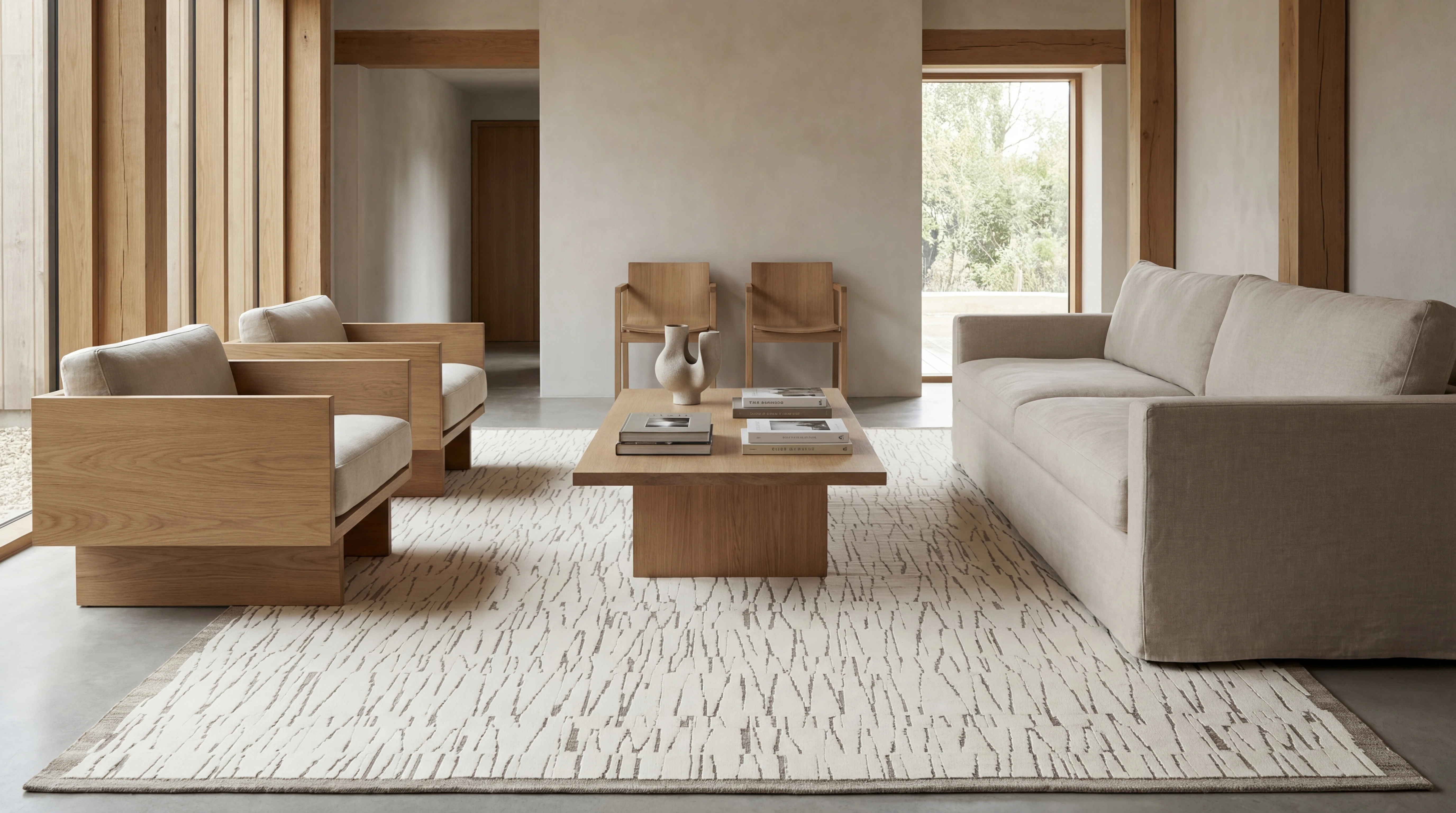
Very few hospitality spaces conform to standard residential rug sizes. Hotel lobbies are large, irregularly shaped, and often interrupted by columns or reception desks. Restaurant floors need to define multiple seating zones simultaneously. Suite bathrooms and dressing areas have specific footprints that a standard 5-by-8 will not address.
Kapetto produces custom sizes across the full wool, jute, and cashmere collections. The process is as follows.
Initial specification. The designer provides the required dimensions, shape (rectangular dimensions are most common; irregular shapes require a detailed floor plan), construction type, and colorway. For large lobby pieces, a site visit to confirm measurements is strongly recommended. Rugs larger than 12-by-18 feet require discussion of loom capacity and may need to be produced in joined sections, a technique that Kapetto's workshop executes with invisible seaming.
Sampling. For significant hospitality commissions, Kapetto provides hand-knotted or loom-knotted hand samples in the specified colorway and construction. These allow the design team to verify color, pile height, and texture before committing to full production. Sample production takes approximately three to four weeks.
Production and lead times. Standard custom sizes (up to 12-by-15) have production lead times of 16 to 24 weeks depending on construction complexity and current workshop capacity. Oversized lobby pieces may require 28 to 36 weeks. Expedited production is possible for a premium and must be discussed at the specification stage, not after production has begun. Building custom rug lead times into FF&E schedules from the earliest project phase is essential — it is one of the longest lead time items in any hospitality fit-out.
Material Selection for Hospitality Applications
The right material for a hospitality rug depends on the specific environment within the property.
Lobbies and public circulation areas. New Zealand wool is the specification workhorse for these environments. It is durable, naturally soil-resistant (the lanolin content in quality wool creates a mild natural barrier to staining), and accepts deep, complex dyes that maintain vibrancy under regular cleaning. Kapetto's Kiri hand-knotted collection is particularly suited to lobby applications where a significant visual statement is required alongside genuine durability. The Nami flat-weave is appropriate for transition zones and lower-traffic circulation areas.
Guest suites and junior suites. The suite environment invites a more luxurious specification. Traffic is light, housekeeping is daily but gentle, and the guest experience is the primary consideration. This is where a cashmere piece can be justified on both experience and specification grounds. The 15mm pile of Kapetto's cashmere collection creates a sensory moment — the first barefoot step from bed to floor — that guests remember and that becomes part of the property's distinct character. For a boutique hotel or luxury resort where differentiation from the corporate hotel experience is a brand priority, this specificity of material choice is exactly the right investment.
Restaurants and bar areas. Hard floor environments with area rugs perform better than wall-to-wall in restaurant settings because they can be pulled and cleaned without shutting down the space. A flat-woven wool or jute rug is the most practical specification, combining texture and warmth with the ease of maintenance that a food-service environment requires. Kapetto's Nami wool flat-weave and Sabi jute are both appropriate for restaurant seating zones.
Spa environments. Spa specification requires particular attention to moisture. Wool and cashmere are not appropriate adjacent to wet areas. For spa corridors and treatment room entry zones, a flat-woven wool in a neutral colorway provides warmth and visual calm while tolerating the elevated humidity of a spa environment better than a pile construction. Areas adjacent to pools or steam rooms require non-natural fiber solutions outside Kapetto's current range.
Maintenance Programs for Hospitality Rugs
A rug is only as good as its maintenance program. For hospitality properties, we recommend the following protocol as a baseline that housekeeping teams and facilities managers can adapt to specific property needs.
Daily. Vacuum using a commercial suction vacuum without a beater bar. Attend to any visible soiling immediately, following the appropriate treatment for the stain type (cold water and mild detergent for most food and beverage spills; professional treatment for oil-based substances). Never allow spills to dry before addressing them.
Monthly. Rotate rugs in high-traffic areas if possible to distribute wear. Inspect pile for crushing in traffic lanes; if significant, arrange for professional pile restoration.
Annually. Professional deep cleaning by a contractor experienced with natural fiber commercial rugs. For wool pile rugs, hot water extraction (steam cleaning) at low moisture is the most effective method. For flat-weave jute and flat-woven wool, dry cleaning or minimal-moisture methods are preferred. Avoid alkaline cleaning agents on wool, which can damage the fiber structure.
Ongoing. Maintain a repair relationship with a rug restoration specialist familiar with hand-knotted construction. Natural wear in high-traffic areas, if caught early, can be addressed through pile re-knotting before it compounds into structural damage. For Kapetto pieces, we can provide referrals to qualified restoration specialists in most major US cities.
The Kapetto Trade Program
Kapetto's Trade Program is built specifically for designers, architects, and procurement professionals working on hospitality projects. It provides the following.
Trade pricing. Registered trade accounts receive discounted pricing on all standard and custom orders. The discount structure reflects project volume, with larger multi-room or multi-property commissions qualifying for enhanced terms.
Custom specification support. Every trade account is assigned a dedicated point of contact who can assist with material selection, fire test documentation, sample coordination, and production scheduling. We understand that hospitality procurement involves multiple stakeholders, long approval chains, and non-negotiable deadlines. Our process is designed to support that reality.
Sample library access. Trade accounts have access to Kapetto's full sample library, including hand-knotted and loom-knotted samples in all current constructions and colorways, as well as custom yarn samples for bespoke color development.
Project photography. For completed hospitality installations, Kapetto coordinates professional photography that documents the project for both client records and potential joint marketing. Several of our most significant recent projects began as trade introductions and have become ongoing relationships across multiple properties.
Starting a Hospitality Specification
The earlier in a project timeline a rug specification is initiated, the better the outcome. Lead times for custom pieces mean that a rug decided in schematic design will be on-site and ready for installation by the time the room is complete. A rug decided during construction documents will create schedule pressure.
The specification process for a Kapetto hospitality piece begins with a conversation. We ask about the environment, the traffic level, the aesthetic intent, the fire code jurisdiction, and the budget range. From that conversation, we can identify the right construction, the right material, and the right size range, and provide a detailed specification sheet that satisfies the documentation requirements of a full FF&E package.
For designers who have not yet worked with Kapetto on a commercial project, the trade program registration is straightforward and the first conversation costs nothing. The rugs that result from that conversation — specified correctly, produced with care, installed at the right moment — have a way of becoming the element guests remember most about a room. That is not an accident. It is what happens when the right material and the right craftspeople are brought to the right problem.
Register for the Kapetto Trade Program or contact us directly to discuss a current or upcoming hospitality project.


