

No single decision shapes a living room more completely than the rug. It establishes the room's zone, determines its warmth, anchors the furniture, and sets the tonal register that every other element responds to. Get it right, and the room feels inevitable — as if it could not exist any other way. Get it wrong, and no amount of beautiful furniture or perfect lighting will quite save it. The rug is not an accessory. It is the foundation on which a living room is built.
This guide covers everything a designer or homeowner needs to make a confident choice: how to size a rug for any living room configuration, which materials suit which situations, how to think about color and pattern, and how specific layout strategies change what a room feels like.
Sizing: The Most Common Mistake and How to Avoid It
The single most common living room rug mistake is choosing one that is too small. A rug that floats in the center of a seating arrangement without anchoring it makes the furniture look untethered and the room look underscaled. The fix is almost always to go larger.
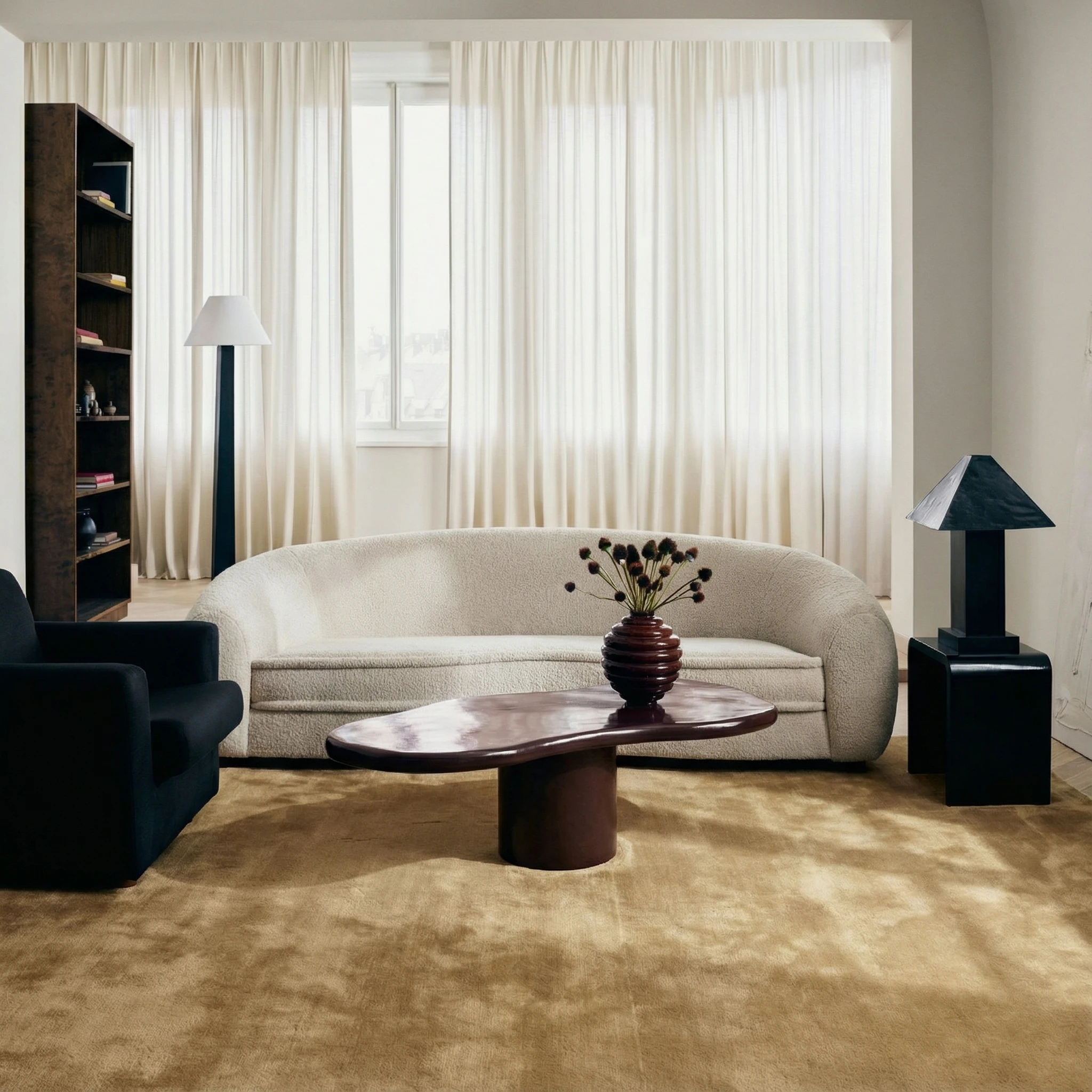
The guiding principle for living room sizing is this: the rug should be large enough that all primary seating pieces have at least their front legs resting on it. In practical terms, this means that for a standard sofa-and-two-chairs arrangement, you are looking at a minimum of 8 by 10 feet, and more commonly 9 by 12 feet in rooms of typical residential scale (14 to 18 feet across).
Here is a size guide by room configuration:
- Small living room (under 12 feet wide): 6 by 9 or 8 by 10. Front legs of sofa and chairs on the rug, back legs off.
- Standard living room (12 to 16 feet wide): 8 by 10 or 9 by 12. All seating anchored, 18 to 24 inches of bare floor visible at walls.
- Large or open-plan living area: 9 by 12 or larger, possibly custom. The rug defines the seating zone within a larger space.
- Sectional sofa: The rug should accommodate the entire footprint of the sectional with all front legs on. This often requires a 10 by 14 or even 12 by 15.
Before finalizing a size, tape out the dimensions on the floor with painter's tape and live with it for a day. What looks generous on paper can feel different in the actual room with real furniture in place.
Material Selection for Living Rooms
Material choice for a living room rug depends on traffic level, household composition, and the level of sensory luxury you are trying to achieve. Here is how to think about the major options:
Wool is the workhorse of fine rug making and an excellent choice for most living rooms. It is naturally soil-resistant (lanolin in the fiber repels moisture before it can set), resilient under foot traffic, and available in an enormous range of pile heights and densities. A quality wool rug will hold its appearance for decades. Our Nami and Kiri wool rugs are made from hand-carded New Zealand wool selected for its exceptional whiteness and durability — well suited to living rooms that see genuine daily life.
Hand-knotted construction at higher KPSI produces rugs that resist crushing and maintain their pile height even in frequently used seating areas. Kapetto's Kiri at 100 to 120 KPSI is a particularly strong choice for living rooms where longevity is a priority alongside beauty.
Cashmere is the choice when sensory experience is paramount and the space allows for a degree of care. Our cashmere loom-knotted rugs at 15mm pile height have a surface that is genuinely unlike anything else — extraordinarily soft, temperature-regulating, and visually luminous. They are ideal for living rooms that function as retreats rather than thoroughfares: a private sitting room, a formal receiving room, a master suite sitting area. For living rooms with heavy foot traffic, pets, or young children, pair cashmere with a quality felt rug pad and establish a no-street-shoes protocol.
Jute and natural fiber rugs work beautifully in living rooms that emphasize organic textures and relaxed informality. Our Sabi natural jute rug brings warmth and earthiness to contemporary and coastal interiors. Natural fiber rugs are not recommended for high-humidity environments or areas prone to spills, as they can be difficult to clean once moisture penetrates the fiber.
Color and Pattern: Anchoring Without Overwhelming
A living room rug operates at scale. What looks like a quiet tone in a sample can read quite differently across 9 by 12 feet of floor. This scale effect cuts in both directions: a color that seems assertive in a small swatch can be exactly right at full size, and a color that seems safe can become oppressively dominant.
The most reliable approach is to treat the rug as part of the room's tonal foundation rather than its focal point. Neutral and warm mid-tones — caramel, sand, warm ivory, soft taupe — work across virtually every furniture palette and adapt gracefully as the rest of the room evolves. Our Cashmere Caramel and Cashmere Latte are designed precisely with this in mind: warm enough to contribute something to the room, neutral enough to never compete.
For rooms where the rug will be a more deliberate statement, consider:
- Deep, saturated tones (forest, navy, terracotta) for rooms with lighter walls and furniture. The rug anchors without making the room feel heavy if the surrounding palette stays light.
- Pattern works best when it has a clear visual logic. Geometric patterns at a scale suited to the room (large-scale repeat for large rooms, smaller for intimate spaces) add interest without chaos.
- High-contrast patterns (black and white, deep navy and cream) can be dramatic and successful, but they do limit the palette options for everything else in the room.
In general, if the furniture and walls are already carrying visual interest, a quieter rug is the wiser choice. The rug does not need to win the room. It needs to complete it.
Layout Configurations
Beyond size, how the rug sits relative to furniture determines the layout's success. There are three classic configurations:
All legs on. Every piece of seating has all four legs on the rug. This requires a large rug (often 9 by 12 or bigger) but creates the most unified, room-like feeling within an open floor plan. It is the most forgiving configuration for busy rooms and works well in large open-plan spaces where you need to create definition.
Front legs on. The front legs of all seating pieces rest on the rug, back legs off. This is the most versatile configuration and works in the widest range of room sizes. It creates a sense of connection between pieces without requiring a very large rug. The visual reading is clean and intentional.
Coffee table only. The rug sits primarily under the coffee table, with seating floating around it. This configuration only works in smaller rooms or when the rug is being used as a graphic element rather than a unifier. It often reads as too small for the space. Use it consciously and only when the rug's design is strong enough to justify it.
Styling: The Details That Finish It
A quality rug pad is not optional. For hand-knotted and loom-knotted rugs, specify a dense felt pad rather than a rubber gripper. Felt absorbs impact, protects the pile from compression, prevents slipping, and allows the rug to breathe. It also adds a subtle but perceptible underfoot luxury that elevates the experience of even an already-beautiful rug.
Layering is an increasingly prevalent approach in contemporary interiors: a flat-weave or natural fiber rug as a base layer, with a smaller, more luxurious piece layered on top. This works particularly well with a jute or cotton base under a cashmere or fine wool centerpiece. It adds depth and allows for greater material contrast within the seating area.
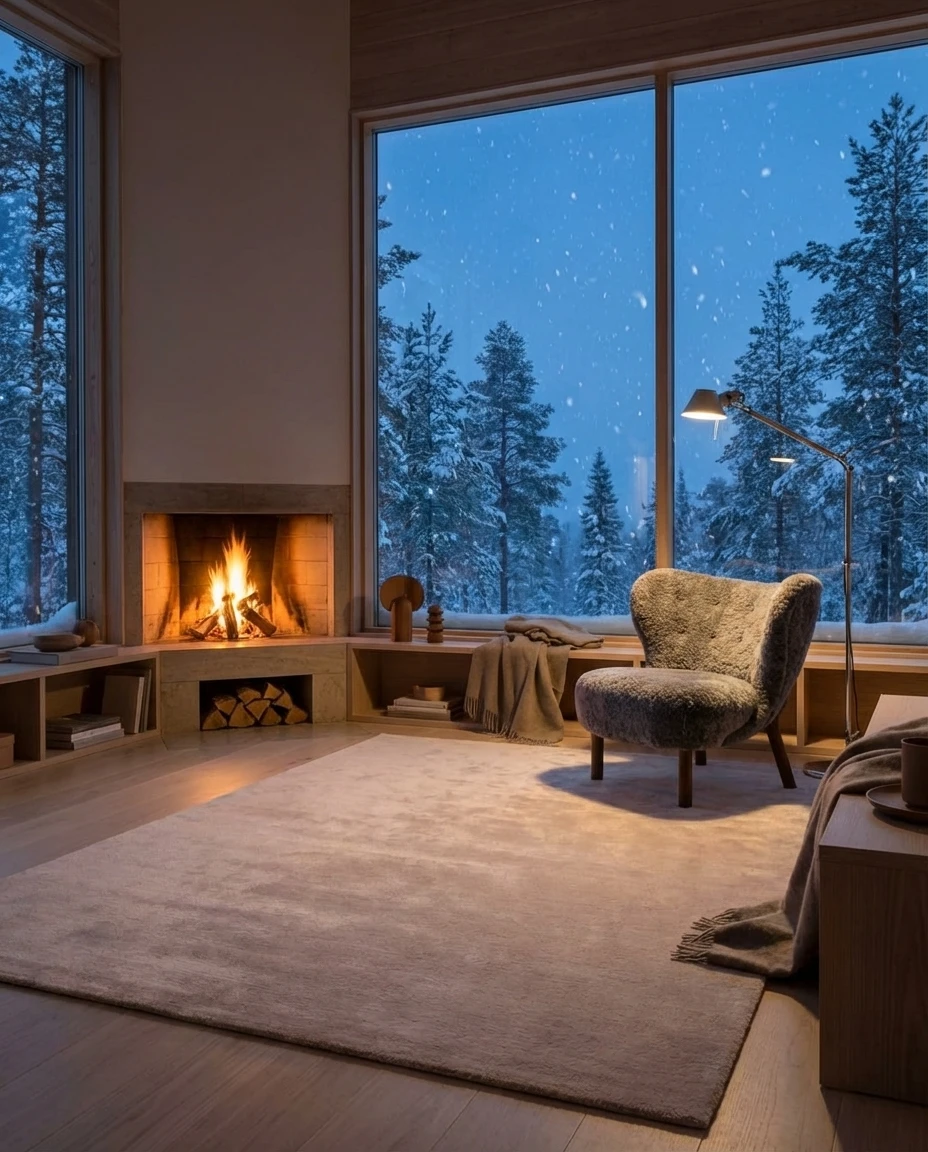
For designers specifying for project work, our trade program provides access to sampling, technical specifications, and lead-time planning support. We work with residential designers, hospitality specifiers, and architects across the United States. You can also explore our completed project gallery to see how Kapetto rugs perform across a range of real interiors, from Californian modernism to East Coast coastal to European country house.
The Living Room Rug as Investment
A hand-knotted or loom-knotted rug at the quality level represented by Kapetto's collection is not a purchase that needs to be repeated. Made with the right materials, specified at the right size, and cared for with basic routine maintenance, a fine rug will outlast a renovation, a furniture refresh, and very probably the interior designer who specified it.
This is the case for buying well once rather than replacing repeatedly. The economics of a $4,000 rug that lasts 50 years are considerably better than three $1,500 machine-made alternatives that last 10 to 15 years each. And the experience of living with a genuinely beautiful handmade object — one that improves with age and carries the mark of human making — is simply not comparable to the experience of living with a manufactured alternative.
The living room rug deserves the same rigor of specification as any other major element in the interior. When it is right, the whole room feels right. That is its power, and why it merits exactly this kind of attention.

