

You do not need an acoustics engineer to tell you that a room full of hard surfaces sounds harsh. Bare concrete floors, glass walls, stone countertops, painted plaster ceilings — together, these materials create a sound environment where voices overlap, music becomes congested, and the simple act of a conversation across a dinner table requires raised voices. The solution is rarely structural. Most of the time, it is a rug for acoustics.
The acoustic benefits of floor coverings are well established in building science, but they are rarely discussed in interior design conversations where aesthetics tend to dominate. Understanding the relationship between pile height, fiber density, and sound absorption allows designers to make specifications that serve both the visual and the sensory experience of a room — and to make the case to clients that a luxury rug is not just beautiful, but genuinely functional.
Why Hard Surfaces Create Echo
Sound travels as a wave. When it encounters a hard, non-porous surface — timber, stone, ceramic tile, polished concrete — the wave reflects rather than absorbs. In a room with multiple hard surfaces, sound bounces repeatedly between them before it dissipates, creating what acousticians call reverberation: the persistence of sound after the original source has stopped. We experience reverberation as echo, muddiness, or that particular loudness that makes an otherwise beautiful room uncomfortable to spend time in.
Reverberation time is measured in seconds, specifically the time it takes for sound to decay by 60 decibels (RT60). A good living room or dining room has an RT60 between 0.3 and 0.5 seconds. Many contemporary interiors with minimal soft furnishings have RT60 values exceeding one second — which is appropriate for a concert hall but exhausting in a domestic setting.
Soft, porous, irregular surfaces do the opposite: they absorb sound waves rather than reflecting them, shortening reverberation time and creating a more comfortable acoustic environment. Upholstered furniture contributes. Curtains contribute. Acoustic panels contribute. And a well-chosen rug, covering a meaningful portion of the floor area, contributes substantially.
The NRC Rating Explained
The standard measure of a material's sound-absorbing capacity is the Noise Reduction Coefficient, or NRC. It runs from 0 (perfect reflection, no absorption) to 1.0 (perfect absorption, no reflection). Hard surfaces like concrete and hardwood have NRC values between 0.01 and 0.05. Carpet and rugs typically fall between 0.25 and 0.60, depending on pile height and fiber type.
A few reference points that put this in context:
- Bare concrete floor: NRC 0.01–0.02
- Hardwood or tile: NRC 0.03–0.05
- Low-pile carpet: NRC 0.20–0.30
- Medium-pile wool or cashmere rug: NRC 0.35–0.45
- Deep-pile or tufted carpet: NRC 0.50–0.65
- Acoustic foam panels (specialist): NRC 0.70–0.95
A high-quality area rug will not transform a room into a recording studio. But replacing a bare timber floor with a medium to high-pile cashmere or wool rug across the main seating area can reduce effective reverberation time by 20 to 30 percent — a change that is immediately perceptible and profoundly affects how comfortable a room feels to occupy.
How Pile Height and Density Affect Sound Absorption
Within the world of rugs, pile height and fiber density are the two variables that most directly determine acoustic performance. They work together: more height means more air trapped within the pile, and more density means more fiber surface area available to absorb sound energy.
A flat-weave rug, beautiful as it is, offers relatively modest acoustic benefit. The weave has little pile depth, so sound waves encounter a relatively hard surface compared to a deeper construction. Flat-weaves like Kapetto's Sabi jute rug provide texture, warmth, and visual interest, but they are not the primary tool for acoustic management.
A hand-knotted rug at medium pile — the 14mm found in Kapetto's Kiri collection, for example — begins to make a meaningful acoustic contribution. The dense knot structure traps air effectively, and the wool fiber itself has natural sound-damping properties.
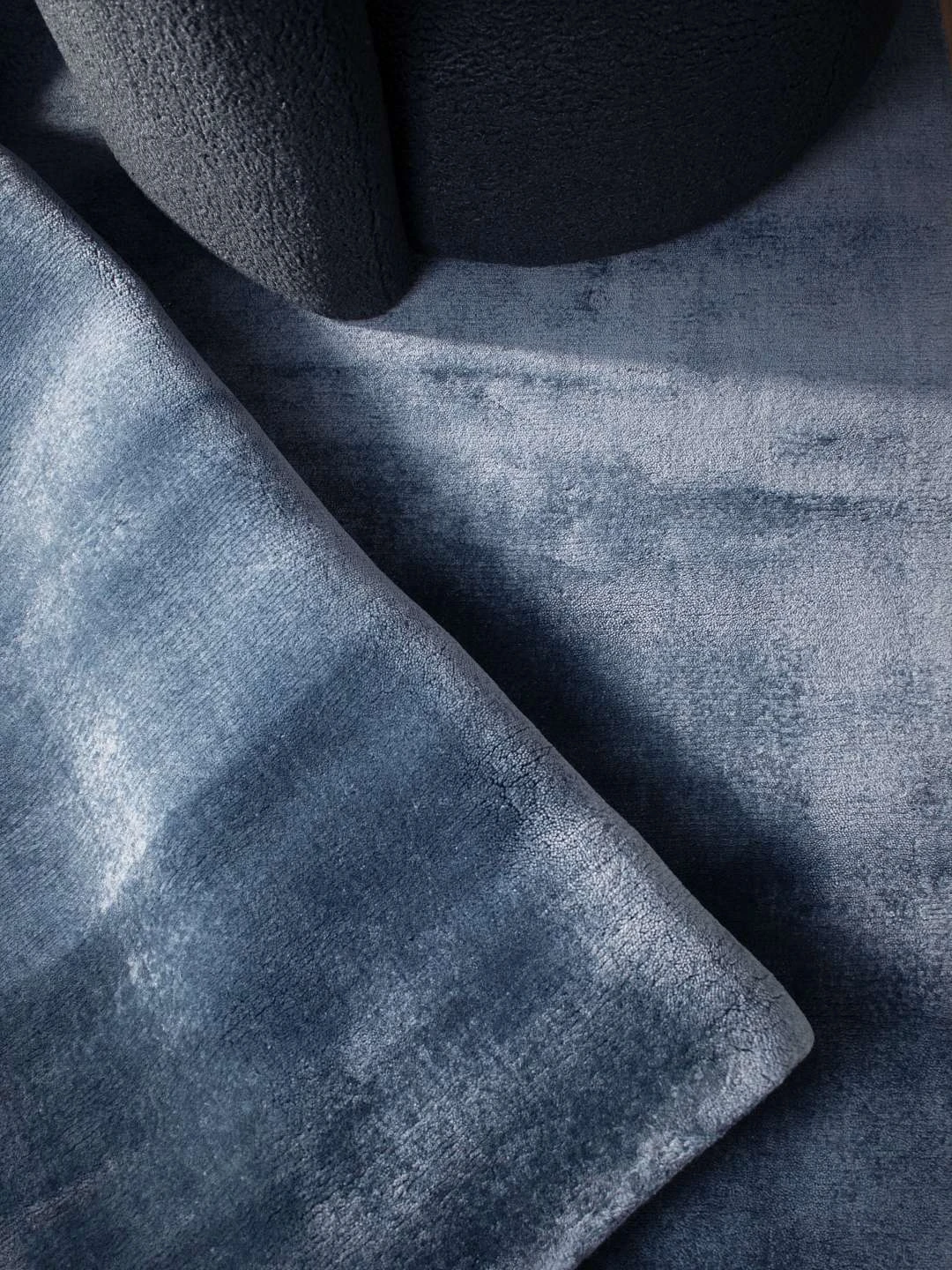
The most significant acoustic benefit comes from the deepest pile combined with the most acoustically active fiber. Kapetto's cashmere collection, with a pile height of 15mm, represents the category where luxury and acoustic function most perfectly converge.

Why Wool and Cashmere Excel Acoustically
Not all fibers perform equally as sound absorbers. The physical structure of the fiber matters enormously. Wool and cashmere share a quality that makes them exceptional acoustic materials: their fibers are naturally crimped and scaly at the microscopic level. This irregular surface structure disrupts sound waves rather than reflecting them cleanly, converting sound energy into small amounts of heat through friction.
Wool, in particular, has been used as an acoustic material in contexts beyond rugs — in studio insulation, in theater seat upholstery, in high-end automotive interiors. Its ability to absorb sound across a broad frequency range, including the mid-range frequencies where speech intelligibility lives, makes it uniquely effective for domestic interiors.
Cashmere performs similarly but with a finer, softer fiber structure. Because cashmere is softer, cashmere rugs are typically constructed with a fuller pile — the 15mm height in Kapetto's cashmere collection is part of what gives the rug its acoustic depth as well as its tactile luxury. The combined effect of high pile and fine, crimped fiber produces a surface that handles sound with the same quiet authority it handles touch.
Synthetic fibers — polypropylene, polyester, nylon — absorb sound less effectively because their smooth, uniform fiber structure reflects rather than diffuses sound waves. They also tend to compress over time, losing whatever pile height they initially had. A natural fiber rug maintains its acoustic performance alongside its appearance.
Home Theaters and Listening Rooms
For dedicated home theater or listening room design, acoustic management moves from a background consideration to a primary specification. In these rooms, where the entire purpose is to experience reproduced sound, reverberation is an enemy.
The standard acoustic recommendation for a home theater is an RT60 below 0.4 seconds across all frequency bands. Achieving this in a room with hard floors requires a combination of wall treatment, ceiling treatment, and floor covering. The floor covering is the easiest and most cost-effective component of this acoustic package, and it often does the most work.
A large, dense wool or cashmere rug covering 60 to 70 percent of the floor area is the baseline recommendation. In a 12-by-18-foot theater room, this means a 9-by-12 rug at minimum — and sizing up is almost always acoustically preferable. Layering a rug pad beneath the rug adds a second layer of absorption and prevents the hard floor from contributing reflected sound through the rug's backing.
For music listening rooms, where accurate timbre and imaging are the goals, the same principles apply. The fiber quality matters here: natural fibers absorb more evenly across frequency ranges, avoiding the situation where a rug absorbs high frequencies effectively but allows low-mid frequencies to bounce unchecked.
Open-Plan Living and the Acoustic Challenge
The most common acoustic challenge in contemporary residential design is the open-plan kitchen-dining-living space. These rooms, by their nature, combine multiple sound sources — cooking, conversation, television, music — across a large, often predominantly hard-surfaced area.
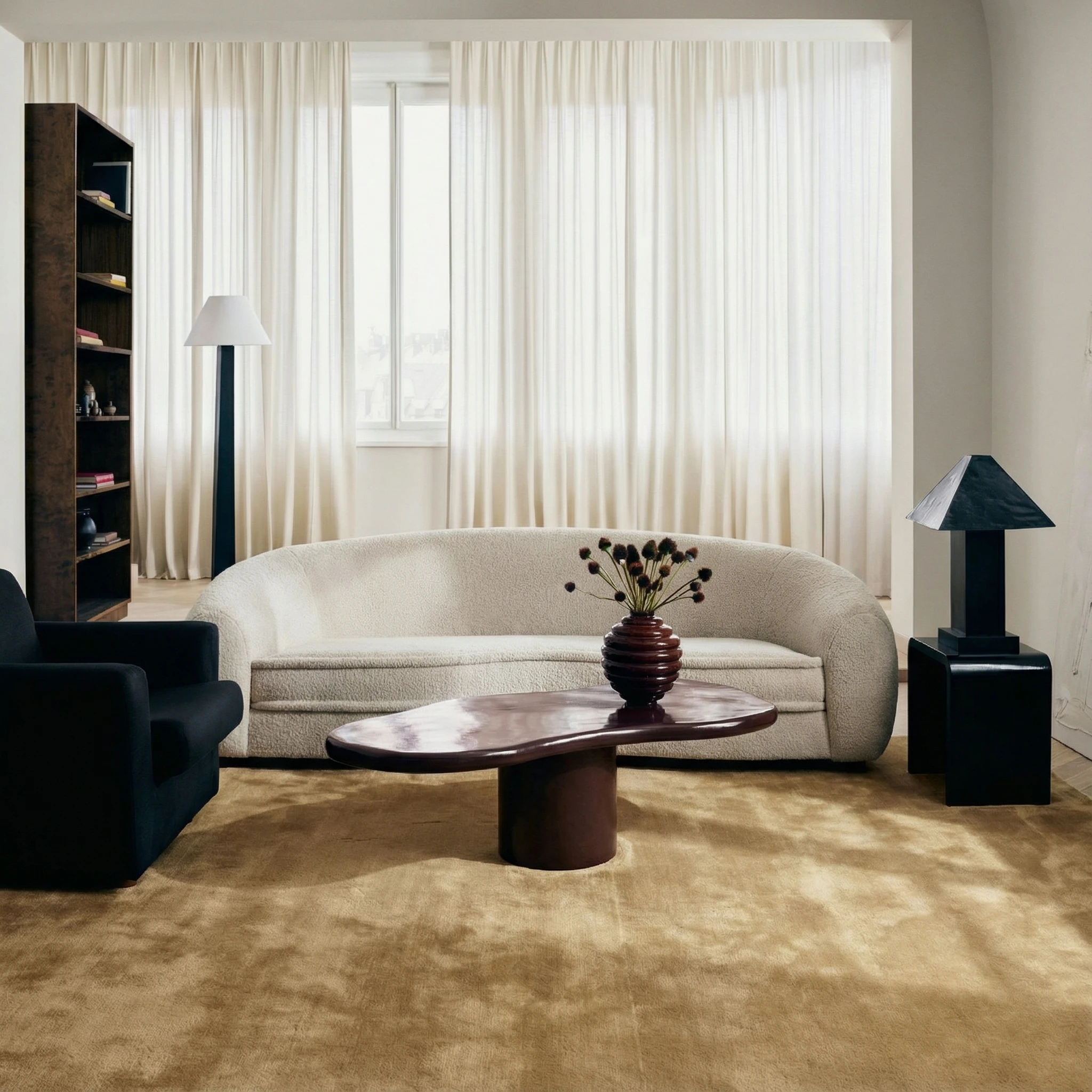
Rugs become essential acoustic tools in these spaces, and the zoning logic of good open-plan design aligns perfectly with acoustic strategy. A rug under the dining table, a rug anchoring the seating area, and potentially a rug in the kitchen zone not only define the functional areas of the space but create distributed pockets of acoustic absorption that prevent the room from becoming one large echo chamber.
Interior designers specifying for open-plan residential projects should consider the total soft surface coverage in the space as an acoustic parameter, not just an aesthetic one. The Kapetto trade program supports designers working on exactly these kinds of projects with dedicated account support, sampling, and specification guidance.
Offices and Work-from-Home Spaces
The same principles that improve domestic acoustics apply with equal force to home offices and commercial interiors. For video calls in particular, room reverberation causes intelligibility problems at the far end of the call — the person you are speaking to hears your voice muddled with its own reflections.
A rug under a home desk, ideally extending to cover the majority of the floor in the work area, is one of the most practical acoustic interventions available. It requires no installation, adds no visual complexity, and can be specified to work beautifully within the room's design intent.
For commercial open-plan offices, the acoustic specification of rugs in breakout and collaboration zones is increasingly standard practice. In these zones, where focused conversation happens against a background of ambient office noise, the acoustic benefit of a dense wool rug is both measurable and immediately noticeable to the people working there.
Practical Specifications for Acoustic Performance
When specifying a rug primarily for acoustic function, keep these parameters in mind:
Pile height of 12mm or more. Below this threshold, acoustic benefit is modest. Kapetto's cashmere collection at 15mm and the Kiri hand-knotted at 14mm both fall within the optimal range for meaningful sound absorption.
Natural fiber construction. Wool and cashmere outperform synthetics for the reasons described above. Hand-knotted construction adds density that enhances absorption.
Coverage of at least 50 percent of floor area. The acoustic benefit of a rug scales with its coverage. A small rug in a large room makes a visual statement but a modest acoustic contribution. Size up wherever the room permits.
A felt rug pad. A quality felt pad adds a secondary layer of acoustic absorption between the rug and the hard floor, amplifying the rug's performance and extending its life.
The rug you choose for a room has always done more than define a zone or anchor a furniture grouping. It shapes the sensory experience of the space in ways that extend well beyond the visual. Choosing it with acoustic function in mind is simply giving it credit for the full range of work it does.
Explore the Kapetto cashmere collection or browse the full wool range to find the right rug for your acoustic and design needs.

