

Rug placement is one of those fundamentals that experienced designers absorb so thoroughly they stop thinking about it consciously — until a client or junior colleague asks why the rug feels wrong, and the answer requires articulating principles that usually live somewhere between intuition and geometry. This guide makes those principles explicit. It covers the configurations that work for every major room type, the spatial math behind the decisions, and the most common placement errors that even skilled designers occasionally repeat.
The Foundational Principle: Rugs Define Space
Before getting into room-by-room specifics, it is worth establishing the principle that underlies every placement decision. A rug is not decoration. It is architecture. It defines the boundaries of a zone within a larger room, and everything within that zone — furniture, people, light — is understood in relation to it.
This means the most important question when placing a rug is not "what size fits this room?" but "what zone am I defining, and what are its edges?" The furniture arrangement follows from the zone; the rug size follows from the furniture arrangement. Working in the other direction — buying a rug and then trying to arrange furniture around it — is the source of most placement problems.
Living Room Configurations
The living room offers three primary rug placement configurations, each with distinct spatial logic.
All legs on. In this configuration, all primary seating pieces (sofa, chairs, ottoman) have all four legs on the rug. This creates the most cohesive zone definition and works best in large rooms where the rug can be generous without overwhelming the space. For a standard sofa-and-two-chairs arrangement, you are typically looking at a 9-by-12 or 10-by-14 minimum to achieve all legs on. This configuration reads as the most resolved and tends to feel the most intentional.
Front legs on. The most common professional configuration: all seating pieces have their two front legs on the rug, with back legs on the hard floor or carpet. This configuration works well in medium-sized rooms and allows a smaller rug (8-by-10 is often sufficient) to define a generous seating zone. The visual logic is that the rug anchors the front edge of each piece, pulling the arrangement inward toward a center point — usually a coffee table — which sits fully on the rug.
Floating. The rug sits between the seating pieces with no legs on it. This configuration is occasionally used for formal arrangements or when the rug itself is the object of attention (a collector's piece where the full surface should be visible), but it is generally the weakest configuration for creating spatial cohesion. The furniture appears to float around the rug rather than relating to it.
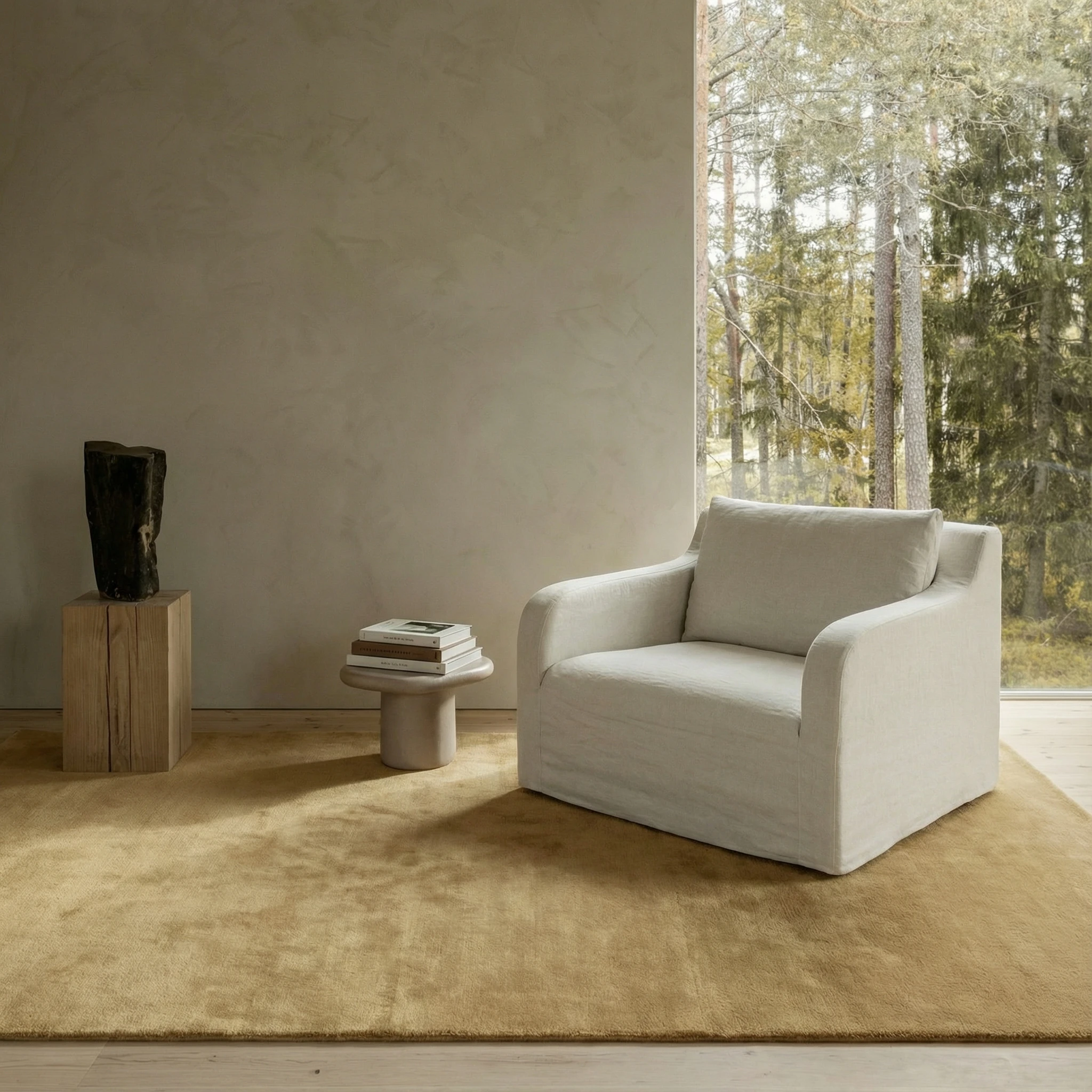
The gap standard. In any living room configuration, the rug should not touch the walls. A perimeter gap of 18 to 24 inches is the standard for most rooms; in very large rooms, up to 36 inches. Less than 18 inches makes the room feel like the rug is trying to be wall-to-wall carpet and failing. More than 36 inches can make the rug appear undersized and the furniture arrangement look adrift.
Dining Room Placement
The dining room rule is the simplest in residential design and also the one most frequently violated.
The rug must extend at least 24 inches beyond the table on all sides. The reason is purely functional: a chair pulled out for a seated diner should still have all four legs on the rug. Most dining chairs, when pulled out to a comfortable seated position, move approximately 18 to 20 inches from the table edge. Adding a few inches of margin puts the minimum rug extension at 24 inches per side.
For a standard 36-by-72-inch dining table seating six, this means a minimum rug size of approximately 8-by-10 feet. For a 42-by-84-inch table seating eight, the minimum is 9-by-12. Designers regularly specify one size too small here, which creates the unfortunate effect of chair legs catching on the rug edge every time someone sits or stands.
Shape matters in dining rooms as well. Rectangular rugs work for rectangular tables; round rugs work for round tables and can be beautiful under a circular table in a room with strong architectural curves. Oval rugs can bridge the two, offering the softness of a curve under a rectangular table in rooms where the angles feel too hard.
Bedroom Placement
The bedroom offers more configuration variety than any other room, because the placement depends on both the size of the bed and the room layout.
Full under-bed placement. A large rug (9-by-12 or 10-by-14 for a king) that extends under the bed and out at least 24 to 36 inches on the sides and foot. This is the most luxurious configuration — it creates a true landing zone all around the bed and makes the room feel complete and considered. The Kapetto Cashmere Caramel in a 9-by-12 is a favored specification for this configuration in king-bed master suites, where the 15mm pile creates an exceptional barefoot experience at the moments it matters most.
Two-thirds placement. The rug extends under the lower two-thirds of the bed, beginning about one-third of the way up from the foot. This works well when the bedside areas are defined by their own furniture (nightstands, reading chairs) and a full-room rug would feel excessive. It is also the economical option when the client's budget is constrained.
Runner configuration. Two runners, one on each side of the bed, with a smaller rug at the foot. This is the most practical configuration for platform beds on very hard or very cold floors, where the primary goal is a warm landing surface. It works better in contemporary, low-furniture bedrooms than in rooms with traditional four-poster or upholstered bed frames, where the scale of the runners can look insufficient.
Layering in the bedroom. A jute or natural fiber flat-weave as a base, with a cashmere rug or sheepskin at the bedside, is a layering approach that combines practicality (the base layer is more durable and covers more area) with focused luxury (the cashmere is where the foot first meets the floor in the morning). This approach is particularly effective in rooms with strong material themes — warm wood, linen, stone — where the natural fiber base reinforces the material story.
Open-Plan Spaces
Open-plan living and dining areas present the most complex placement challenge because the rug must do more than define one zone — it must define multiple zones while maintaining visual coherence across the full open space.
The most reliable approach is to use rugs of related but distinct character in each zone. In a combined living and dining space, a pile rug (wool or cashmere) in the living zone and a flat-weave or natural fiber rug (jute, flat-woven wool) in the dining zone creates clear differentiation that feels intentional rather than arbitrary. The materials should share a tonal family — warm caramels and naturals, or cool greys and off-whites — to maintain the visual flow across the open plan.
The gap between the two rugs is important. Too close, and the zones merge uncomfortably. Too far, and the bare floor between them creates an awkward no-man's land. A gap of 12 to 18 inches is usually correct, sufficient to read as a visual separation while keeping the two zones in conversation.
In very large open-plan spaces — the great rooms and loft interiors that appear frequently in high-end residential projects — a single very large rug can anchor a full living arrangement without competing with an adjacent kitchen or dining area, provided the rug is large enough (10-by-14 or 12-by-15) to genuinely define its zone. Undersized rugs in large open-plan spaces are the single most common error in this room type.
Layering Rugs
Layering has become one of the most versatile tools in the contemporary interior designer's vocabulary. Done well, it adds depth, warmth, and a sense of collected personality that single-rug rooms rarely achieve.
The principles for successful layering are few but important. The base layer should be larger and lower-key — a jute flat-weave, a plain wool, a sisal. The top layer should be smaller (approximately half to two-thirds the size of the base) and higher interest: a cashmere piece, a patterned kilim, a vintage tribal rug. The top layer should be placed with intention, not centered but offset toward the primary furniture grouping.
Alignment matters. The top rug should have at least one edge that aligns approximately with a furniture element — a sofa leg, the front edge of a coffee table — rather than floating in isolation. This anchors it visually and prevents the layered arrangement from looking accidental.
In terms of texture and material, contrast tends to work better than similarity. A flat-woven jute base under a high-pile cashmere top layer creates a compelling material dialogue. Two similar-pile rugs layered together tend to look like a mistake rather than a choice.
Common Mistakes to Avoid
Too small, every time. The single most prevalent error in residential interiors. When in doubt, go up a size. An 8-by-10 room rug in a room that needs a 9-by-12 makes everything in the room look smaller and more disconnected.
Rugs pushed against walls. Maintain the perimeter gap. A rug that touches or nearly touches a wall looks like it was purchased in the wrong size and stretched to fill.
Misaligned axes. In rectangular rooms with rectangular furniture arrangements, the rug should be parallel to the primary walls. A rug placed at even a slight angle to the room's geometry creates a subtle visual anxiety that is hard to articulate but immediately felt.
Wrong rug for the traffic level. A delicate cashmere rug in a mudroom entry or high-traffic corridor is a specification error, not a design choice. Match the material to the traffic: wool or jute for high-traffic zones, cashmere for low-traffic luxury spaces. Kapetto's wool collection and Sabi jute collection are the right choices for areas that need durability; the cashmere collection rewards spaces that can be properly appreciated.
No rug pad. Always specify a quality rug pad. It protects the rug, protects the floor, prevents slipping, and makes the rug feel better underfoot. It is not optional.
For designers who want to explore Kapetto rug specifications in more detail, including custom sizing for unusual room configurations, the Kapetto Trade Program provides dedicated support, trade pricing, and sample access. Most placement questions resolve themselves once the right size and material are on the floor.

