

Not all wool is the same. This is a statement that surprises people who have not thought carefully about fiber before, because wool seems like a category — a single material with predictable properties. In fact, wool quality varies enormously depending on breed, climate, diet, altitude, and husbandry practices. And at the top of that quality spectrum, by near-universal agreement among rug makers and textile experts, sits New Zealand wool. New Zealand wool rugs have earned their reputation not through marketing but through measurable fiber science. Here is why the origin of the wool matters more than most buyers realize.
The Fiber Properties That Set New Zealand Wool Apart
New Zealand wool comes primarily from Merino and Corriedale sheep raised on the South Island's high country — vast, clean pastures at elevation, with cold nights and good rainfall. These conditions produce a fiber with three properties that are critical for luxury rug making: exceptional whiteness, natural elasticity, and an unusually smooth surface at the microscopic level.
Whiteness
Wool's natural color ranges from creamy white through various shades of yellow, tan, and grey. New Zealand wool, partly due to the mineral content of the South Island's pastures and partly due to the breeds favored there, produces among the whitest raw fleece of any wool-producing region in the world. This matters enormously for rug making because whiteness determines dye absorption.
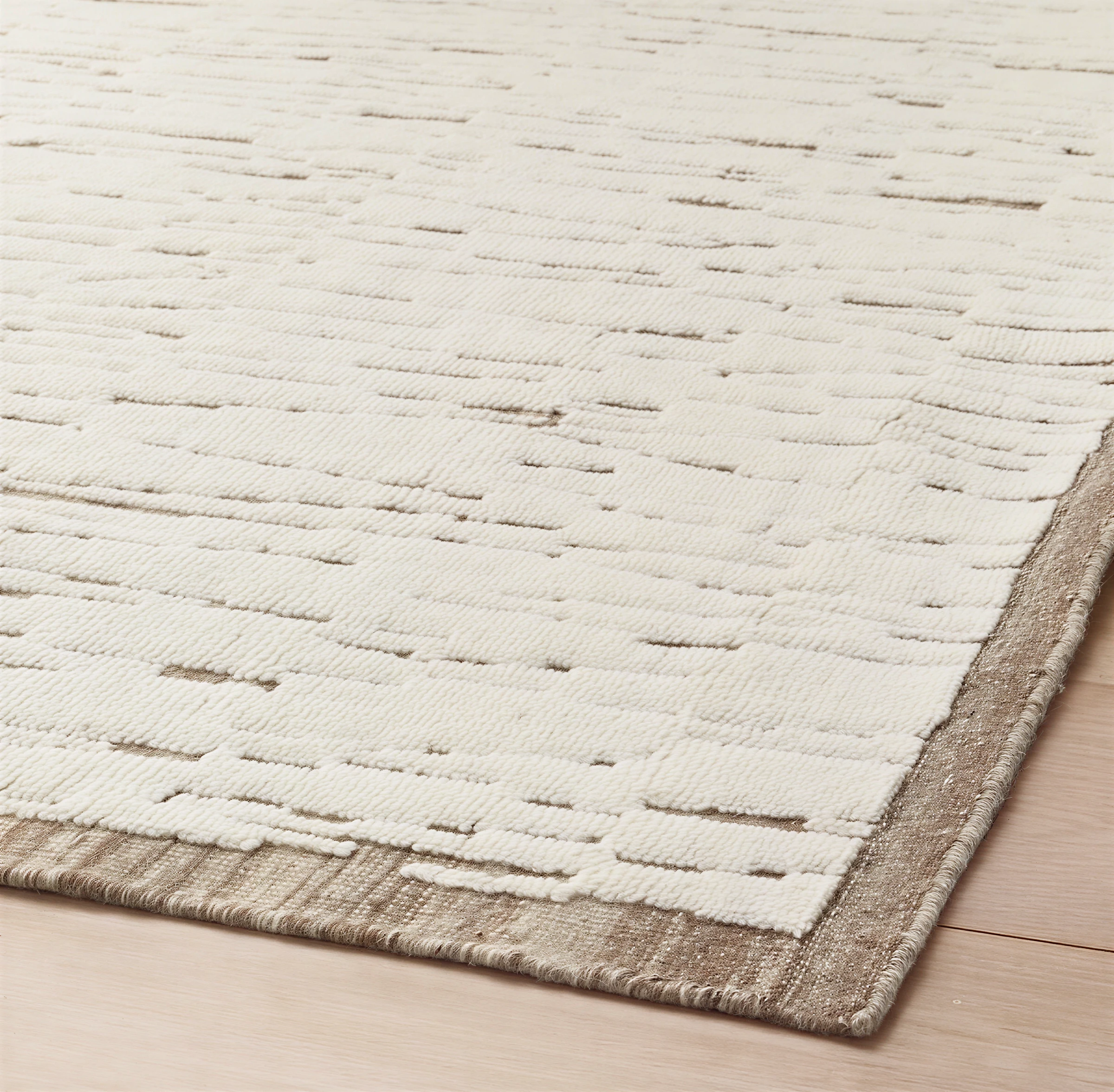
When a dyer works with a less white wool, the natural undertone of the fiber mixes with the dye color and shifts the result — yellowing a blue, warming a grey, dulling a red. With New Zealand wool, the dye color reaches the consumer's eye with remarkable purity. A sapphire stays sapphire. A warm ivory stays ivory. This is why New Zealand wool rugs are known for their color richness and longevity — the color is true from the first day and, with normal care, holds that truth for decades.
Elasticity and Resilience
Wool fiber is naturally crimped — it has a helical structure that behaves like a tiny spring. This crimp is responsible for wool's resilience: its ability to recover its shape after compression. When you walk on a wool rug, the fibers compress under foot pressure and then spring back when the weight is removed. Over time and with repeated compression, all fibers will lose some of this springiness — but New Zealand wool's crimp structure is notably finer and more consistent than most comparable wools, meaning it recovers more fully and holds its pile height longer.
For rugs used in high-traffic areas — hallways, living rooms, hospitality spaces — this resilience is not a luxury property. It is a practical one. A less resilient wool will begin to show wear paths within a few years. New Zealand wool, properly knotted and maintained, will maintain its surface for a generation.
Surface Smoothness and Dye Absorption
At the microscopic level, wool fiber has a scaly surface — overlapping cuticle cells that protect the inner cortex. The fineness and regularity of these scales varies by breed and region, and this variation affects both the softness of the fiber and its ability to absorb dye evenly. New Zealand Merino and Corriedale wool has relatively fine, regular scales, which means dye molecules penetrate evenly across the fiber's length and depth. The result is color that is consistent from fiber to fiber and from the surface of the pile to its base.
How New Zealand Wool Compares to Other Wools
The rug industry works with wool from many regions, each with particular strengths. Understanding how New Zealand wool compares to the alternatives helps clarify why it holds its premium position for the best wool for rugs.
Indian wool is widely available and cost-effective, and it is used in the majority of the world's machine-made and moderately priced hand-tufted rugs. It tends toward a coarser fiber diameter and a more variable whiteness, which limits color fidelity. It is a reasonable choice for entry-level rugs but is not used in fine hand-knotted work where color and longevity are paramount.
Afghan and Iranian wool has a distinguished history in traditional rug making and produces a firm, dense pile well-suited to tribal and geometric patterns. It is typically lanolin-rich, which gives it good natural soil resistance but a slightly less receptive dye surface. The color palette achievable with Afghan or Iranian wool, while beautiful in its own right, is less versatile than New Zealand wool.
Tibetan and Himalayan wool is prized for its natural luster and warmth. Grown at altitude, it tends to be coarser than Merino but has a natural sheen that gives rugs a subtle luminosity. It is used in some of the world's finest hand-knotted rugs, particularly in traditional Tibetan designs.
New Zealand wool occupies a unique position: it combines the whiteness and dye receptivity that allow fine color work, the elasticity that delivers lasting resilience, and a fiber fineness that produces a surface soft enough for bare skin. No other single wool source matches all three of these properties simultaneously, which is why the best wool for rugs — across color-critical, high-use, luxury applications — is consistently New Zealand Merino or Corriedale.
How Kapetto Sources New Zealand Wool
Kapetto works with wool merchants in Bhadohi who source directly from accredited New Zealand wool exporters, with full traceability from farm region to workshop. The wool arrives as raw-spun yarn, is inspected for fiber consistency and whiteness at the workshop level, and is dyed in house using processes calibrated specifically for New Zealand fiber's dye uptake characteristics.
This traceability matters for two reasons. First, it ensures consistency across production runs — that a rug ordered today will match a rug ordered six months from now in the same colorway. Second, it is part of Kapetto's broader commitment to supply chain transparency, detailed on the Sustainability page, which includes the labor and environmental standards applied at every stage of production.
The sourcing relationship is also selective. Not all New Zealand wool is equal within that category — fiber diameter, staple length, and wash performance all vary by lot. Kapetto's workshop partners work with wool from specific regions and clip seasons that consistently meet the quality benchmarks required for fine hand-knotted and loom-knotted work.
The Collections That Showcase New Zealand Wool
Two Kapetto collections are built on New Zealand wool as their primary fiber: Kiri and Nami.
Kiri Hand-Knotted
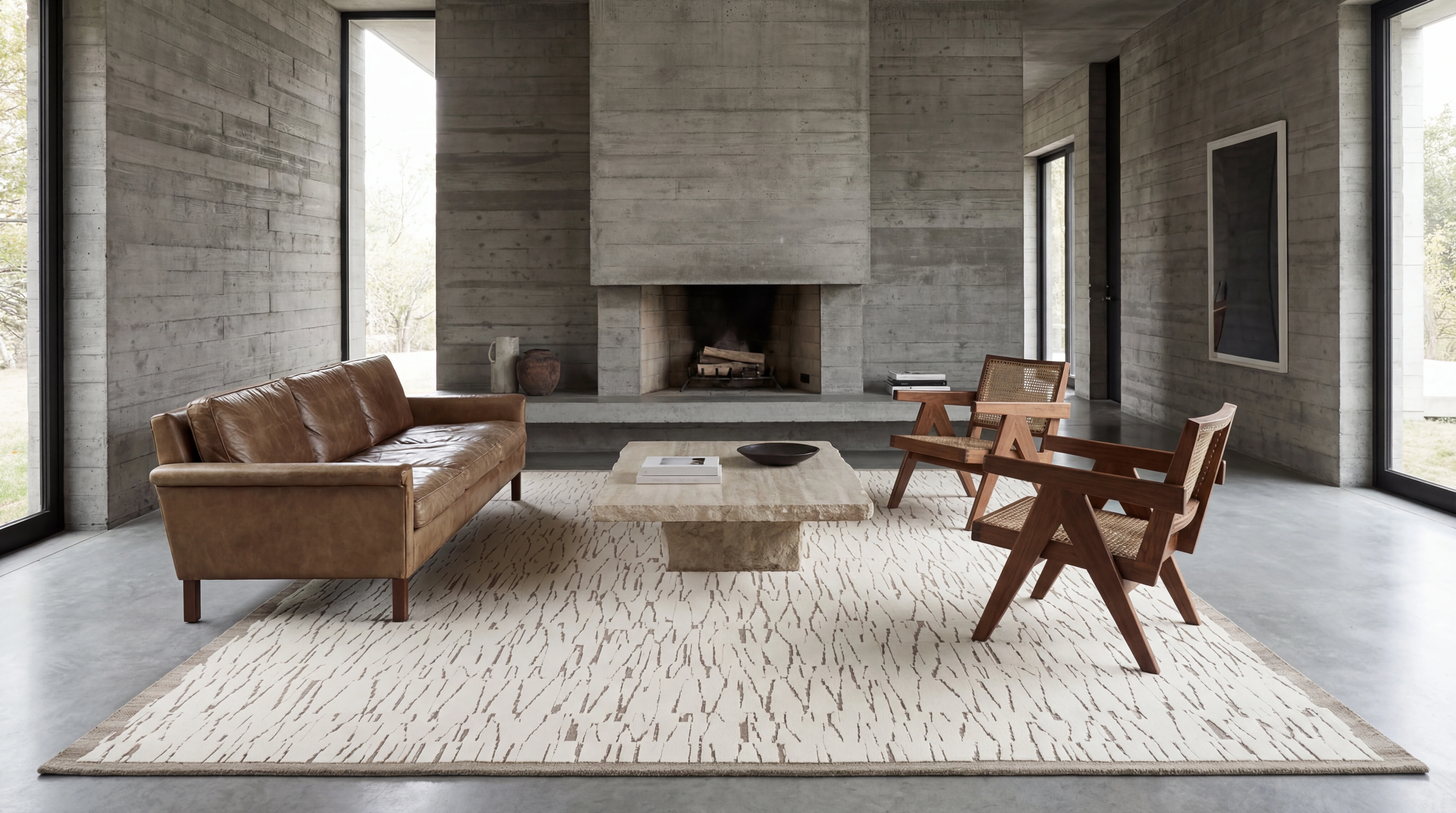
Kiri is Kapetto's flagship hand-knotted collection, woven by master artisans in Bhadohi using the Persian knotting technique at a density that allows for fine pattern detail without sacrificing the tactile richness that defines a great wool rug. The New Zealand wool pile, at a carefully calibrated height, captures light with a gentle depth — deeper in shadow, slightly brighter where the fiber tips catch ambient light, creating a surface that shifts character across the day.
At 14mm pile height, Kiri sits between the firm texture of a lower pile and the deep luxury of cashmere. It is the right choice for living rooms, dining rooms, and hospitality spaces where durability and beauty must coexist without compromise.
Nami
Nami takes New Zealand wool in a different direction: a lower-profile, more textural surface that suits modern and transitional interiors where a quieter, more understated floor treatment is needed. The pile height and weave structure of Nami emphasize the wool's natural fiber variation — the slight irregularity that distinguishes handmade from machine-made and gives the surface its honest, organic character.
Explore the full Wool Collection or learn more about the artisans who create these pieces at Our Artisans. Designers and architects working on projects can request samples and extended specification information through the Kapetto Trade Program.

