

The history of Indian rugs begins not in India but in Persia, carried westward by political upheaval and transformed by the ambitions of emperors. Today, the town of Bhadohi in Uttar Pradesh produces more hand-knotted rugs than almost anywhere else on earth — and the lineage connecting those looms to the Mughal court is unbroken, running through five centuries of political change, colonial disruption, and cultural resilience. To understand why Indian rugs are what they are, you must first understand the world that made them.
The Persian Foundation: Art Before India
Before the Mughals brought rug weaving to the Indian subcontinent, Persia had already developed one of the world's great textile traditions. By the fifteenth century, the carpet workshops of Tabriz, Kashan, and Isfahan were producing hand-knotted rugs of extraordinary sophistication — intricate arabesques, hunting scenes, garden compositions, and medallion designs woven in silk and wool with knot counts that remain astonishing even by contemporary standards.
Persian rug making was not a folk craft. It was a court art, patronized and directed by rulers who understood textiles as statements of power, refinement, and civilization. The Shah's carpet workshops employed master designers who created full-scale cartoons from which teams of weavers worked simultaneously, translating the design into thousands of individual knots. The organization, the aesthetic language, and the technical standards developed in those workshops would travel to India and find fertile ground.
Babur, Humayun, and the Arrival of Weaving
The Mughal dynasty that would transform Indian rug making was itself a transplant. Babur, the founder of the Mughal Empire, was a Central Asian ruler of Timurid descent who spoke Chagatai Turkish and admired Persian literature and aesthetics. When he conquered northern India in 1526, he brought with him a court culture oriented toward Persian artistic traditions — including an appreciation for fine textiles.
Humayun, Babur's son and successor, spent fifteen years in exile at the Safavid Persian court of Shah Tahmasp after being driven from India by rivals. Those years in Persia transformed him. He immersed himself in Persian court culture, formed close relationships with Persian artists and craftsmen, and when he returned to reclaim the Mughal throne in 1555, he brought Persian masters with him. Among those masters were weavers.
Akbar: The Emperor Who Built the Industry
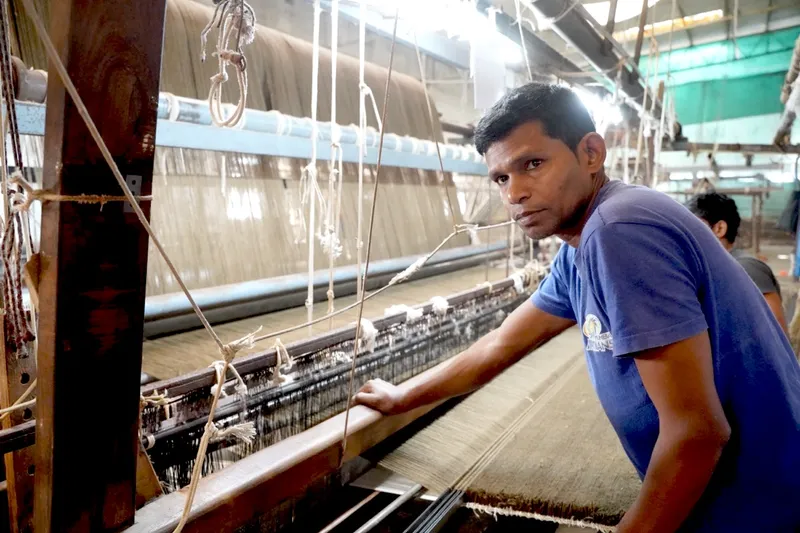
It was under Akbar, Humayun's son and the greatest of the Mughal emperors, that rug making in India became a genuine industry. Akbar ruled from 1556 to 1605, and his reign coincided with a sustained engagement with Persian craftsmanship that would define Indian luxury textile production for centuries.
Akbar established royal karkhanas — imperial workshops — in Agra, Fatehpur Sikri, and Lahore. He brought Persian master weavers to train Indian artisans in the techniques of hand-knotting, design translation, and dye chemistry. The Persian knotting tradition merged with Indian dyeing knowledge and local fiber resources to produce something genuinely new: a hybrid aesthetic that combined Persian compositional principles with Indian color sensibility and indigenous motifs.
The workshops Akbar established were not cottage industries. They were organized production facilities with master designers, trained weavers working in teams, and quality standards enforced by court supervisors. Akbar's historian Abu'l-Fazl, writing in the Ain-i-Akbari around 1590, describes the carpet workshops in some detail, noting the involvement of Persian masters and the emperor's personal interest in the quality of the work.
The rugs produced in these royal workshops were among the finest ever made. Examples surviving in museums — in Jaipur, Vienna, Washington, and London — show knot counts exceeding 300 per square inch, compositions of breathtaking complexity, and colors that have retained their depth across four and a half centuries.
Agra and Lahore: Twin Centers of Excellence
Under Jahangir and Shah Jahan, Akbar's successors, the rug workshops at Agra and Lahore reached their full flowering. Agra, already the site of the imperial court and of what would become the Taj Mahal, was the primary center of Mughal patronage. Its workshops produced rugs for the palaces, for diplomatic gifts, and for the personal use of the royal household.
Lahore, then a major Mughal administrative center, developed its own distinct weaving tradition in parallel. Lahore rugs tend to be slightly more robust in construction than Agra pieces, with a design vocabulary that reflects the region's position at the crossroads of Central Asian and Indian aesthetic currents. Both cities trained generations of master weavers whose descendants would eventually disperse across northern India as the Mughal political structure began to weaken.
The Decline of Mughal Power and the Dispersal of Weavers
The late seventeenth and eighteenth centuries saw the gradual fragmentation of Mughal authority. As the empire contracted under Aurangzeb's overreach and the pressures of Maratha power, the great karkhanas lost their royal patronage. Master weavers who had worked under imperial commission moved outward from the centers of power, carrying their skills with them.
Many settled in the towns and villages of the Gangetic plain, establishing smaller family workshops and taking local commissions. The knowledge — the knotting techniques, the design vocabulary, the dye traditions — survived and adapted. It was during this period of dispersal that the craft took root in the Mirzapur-Bhadohi-Varanasi belt of what is now Uttar Pradesh, a region whose location on trade routes and access to clean water for dyeing made it naturally suited to textile production.
The British Colonial Era: Crisis and Transformation
The arrival of British commercial power in India transformed rug production in ways both destructive and generative. On the destructive side: the East India Company's aggressive promotion of British manufactured goods decimated many Indian textile industries, and the rug trade was disrupted by changing patterns of patronage as Mughal and regional court structures collapsed.
But British India also created new demand. British administrators and merchants developed a taste for Indian rugs — particularly the large, formally patterned pieces that suited Victorian interior fashion. Export markets opened. Commercial production scaled up. The prison workshop system introduced by the British in some regions (including the notorious Agra Jail carpets of the mid-nineteenth century) represented a troubling chapter in the history of Indian rug making, but it also demonstrated the global commercial appetite for Indian craftsmanship.
By the late nineteenth century, Bhadohi had emerged as a significant center of commercial rug production, with a workforce of trained weavers producing pieces for export through Calcutta to British and American markets. The region's infrastructure of local knowledge, established supply chains, and trained artisan families made it ideal for scale production without sacrificing craft standards.
The Modern Renaissance: Quality Over Volume
Post-independence India, particularly from the 1970s onward, saw a significant reassessment of rug production values. International buyers began seeking higher quality alongside competitive pricing. Organizations like GoodWeave International emerged to address legitimate concerns about labor conditions in the industry, establishing certification systems that allowed ethical producers to distinguish themselves in the global market.
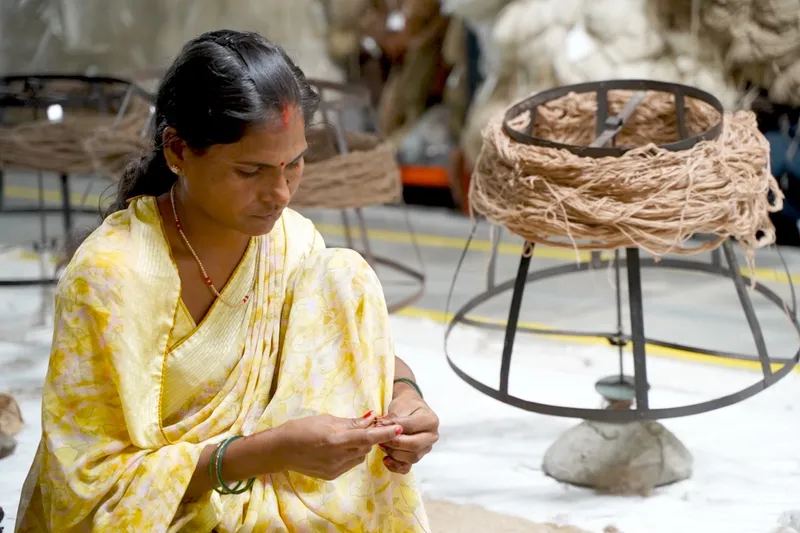
The more significant development was a generational shift in what Bhadohi's best workshops chose to make. Rather than competing on volume and price with machine-made alternatives, a group of producers chose to compete on quality — returning to higher knot counts, natural dyes, premium fibers, and the kind of design collaboration with international designers that produced genuinely exceptional rugs rather than adequate ones.
This is the tradition in which Kapetto operates. Our Kiri hand-knotted collection and our cashmere rugs are made in Bhadohi workshops whose master weavers represent the living continuation of a five-century lineage. The Persian knot their predecessors learned under Akbar's patronage is the same knot they tie today. The attention to pile consistency, color evenness, and structural integrity that defined the great Mughal workshop pieces is the standard we hold our artisans to in every piece we make.
Kapetto and the Living Legacy
The Mughal legacy is not merely historical for us. It is present in every decision we make about craft standards and material quality. When we specify New Zealand wool for its whiteness and dye uptake, we are working within a tradition of material selection that the Mughal masters understood intuitively. When we collaborate with our artisans on the proportion of pile height to knot density, we are engaged in the same conversation that court designers and master weavers have been having for five centuries.
What has changed is the context. We make rugs for contemporary homes in California, New York, and London rather than for Mughal palaces in Agra. Our palette has evolved toward the warm neutrals and quiet sophistication that today's interiors demand. Our sustainability commitments and GoodWeave certification reflect values that would have been unthinkable in the karkhana system. But the craft itself — the knot, the loom, the human hand, the patient accumulation of thousands of individual acts of skill — is unchanged.
India became a rug-making powerhouse because an exiled emperor brought Persian masters to a royal court, and because generations of Indian artisans absorbed that knowledge and made it their own. That story continues in Bhadohi today. It continues in every Kapetto rug.
To explore the craft further, visit our craft pages, meet the artisans who make every piece, and discover our wool and cashmere collections.


