

Every Kapetto rug begins not with a design brief or a color palette, but with a pair of hands. The master rug weavers of Bhadohi, India, carry within them a depth of knowledge that no manual can encode and no machine can replicate. Passed from father to son, from master to apprentice, across generations spanning centuries, this knowledge lives in the fingers — in the precise tension of a knot, the instinctive reading of a loom, the practiced eye that catches an imperfect row before it becomes a flaw.
At Kapetto, the rug artisans who create our collections are not anonymous workers. They are named, known, and celebrated. What follows are portraits of seven master weavers whose skill, discipline, and philosophy shape every piece we make.
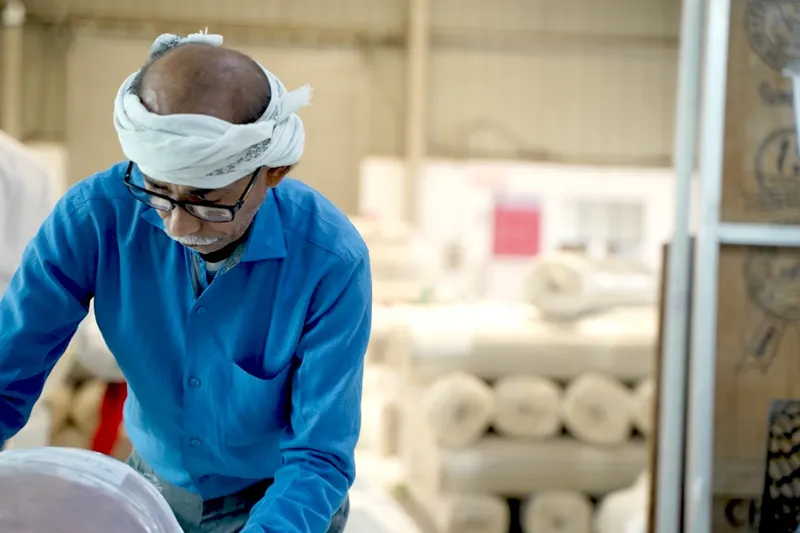
Ram Sevak: Four Decades at the Loom
Ram Sevak began weaving at the age of fourteen, sitting beside his father in a small workshop on the outskirts of Bhadohi. He is now in his mid-fifties, and his hands move across the loom with a fluency that is almost musical. He specializes in cashmere loom-knotting, the technique behind Kapetto's signature Cashmere collection, and he has an exceptional sensitivity to pile evenness — the quality that gives a cashmere rug its smooth, cloud-like surface.
"A rug tells you when something is wrong," Ram Sevak says through our translator. "You feel it in the tension before you see it. I have been weaving long enough that my hands understand before my eyes do."
That intuition took decades to develop. He estimates he spent the first ten years simply learning to read a loom — to understand how humidity affects tension, how the morning light differs from the afternoon and influences color judgment, how to pace a day's work so that fatigue does not compromise precision in the final hours. His rugs are distinguished by their consistency across large formats, a particular challenge in cashmere where the fiber's fineness magnifies any variation.
Dablu Master: The Geometry Specialist
In the workshops, Dablu is addressed as "Dablu Master" — a title that carries its own weight in Bhadohi's weaving community. He has spent thirty-two years specializing in geometric and lattice patterns, the kind of exacting repeat work that demands both mathematical precision and an intimate understanding of how color behaves across a large pile surface.
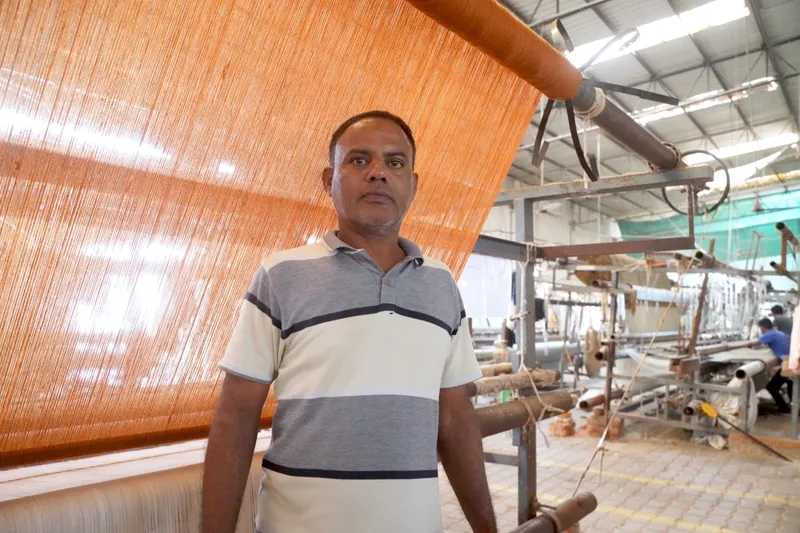
Dablu's great insight is that a geometric rug is not drawn — it is counted. Every knot in a repeating pattern corresponds to a number in a mental grid that he carries with him without reference to a paper chart. When Kapetto introduced the Kiri hand-knotted rug with its structured allover design, it was Dablu who oversaw the translation of the pattern into a loom language the team could follow.
"Young weavers want to work fast," he says. "I teach them to work right. Speed comes after correctness. It never comes before."
Mohan Lal: The Color Reader
Mohan Lal does not weave by specification alone. After twenty-seven years working with hand-dyed yarns, he has developed a sensory relationship with color that colleagues describe as almost uncanny. He can detect dye lot variations invisible to the untrained eye — the kind of subtle shifts that, distributed across a nine-by-twelve rug, would create an uneven wash of tone that reads as a defect under raking light.
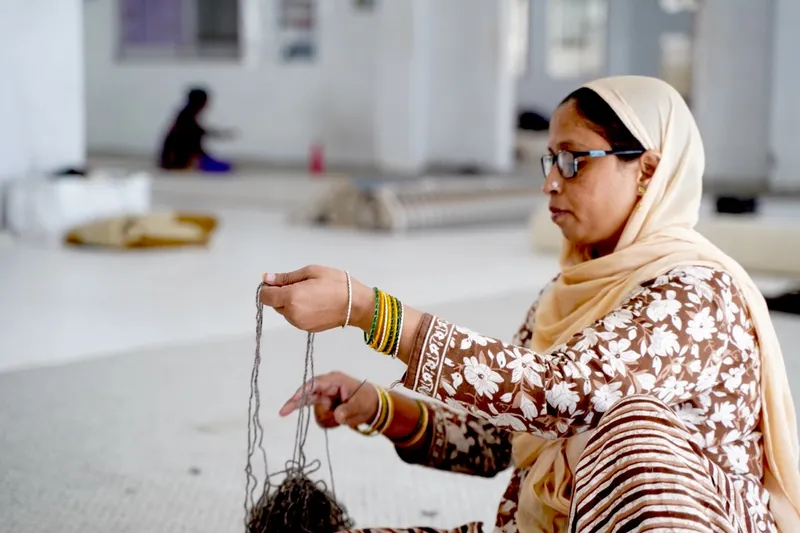
Before each rug begins, Mohan Lal sorts through the dyed yarn skeins by hand, grouping them by visual consistency. It is a process that can take the better part of a morning, and he considers it as fundamental as any work done at the loom itself. "The rug lives or dies by the yarn you start with," he explains. "If the color is not right from the beginning, nothing you do later will save it."
His expertise informs the rich, even colorways found across Kapetto's cashmere variants — the warm caramel, the softened latte, the dusty rose, the quiet lagoon blue — each of which requires a level of color consistency across large yardage that only a practiced eye can guarantee.
Rajesh Kumar: Master of the Finishing Room
Rajesh Kumar occupies a role that many outside the trade overlook: he is the master of the finishing room, responsible for the final stages that transform a woven textile into a polished product. Washing, stretching, clipping, leveling the pile — these are the processes that determine how a rug actually feels and functions in a room, and Rajesh has devoted twenty-four years to perfecting them.
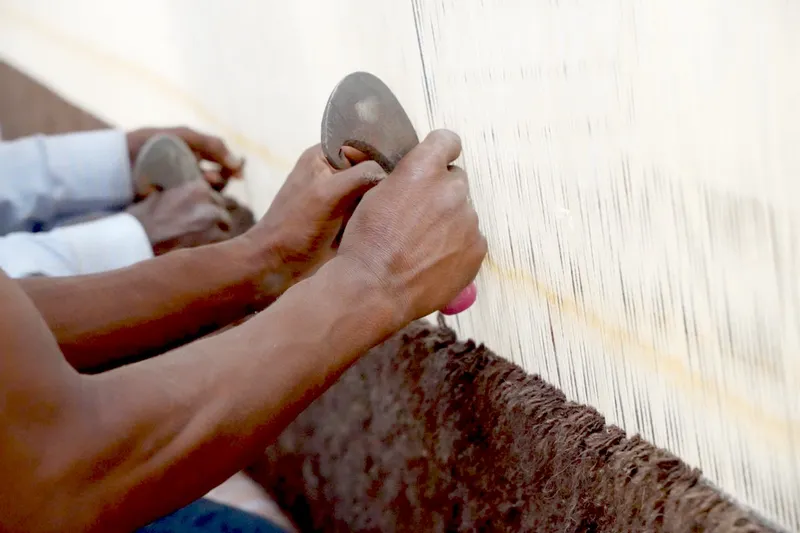
The 15mm pile height that distinguishes Kapetto's cashmere collection — full enough to feel genuinely plush underfoot, controlled enough to avoid the shapeless appearance of a deep shag — is partly a function of Rajesh's clipping precision. He works with large scissors across the rug's surface, leveling the pile by hand, a process that requires sustained attention across pieces sometimes measuring twelve feet or more.
"Every rug has a direction," he says. "You have to find it and work with it. You cannot fight the fiber." His approach is a reminder that the finishing room is not where perfection is rescued — it is where it is completed. The rug arrives from the loom good. Rajesh makes it exceptional.
Aman Singh: The Structural Foundation
Aman Singh is the youngest of the master weavers in this profile, though at thirty-eight he already carries nineteen years of experience. His specialty is structural integrity — the warp and weft system that forms the skeleton of every rug. Where other masters focus on surface qualities, Aman thinks from the inside out.
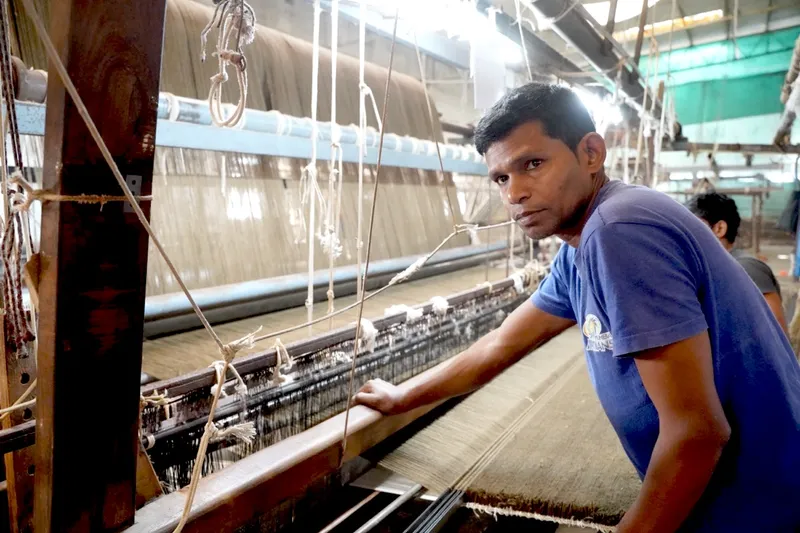
Setting up a loom correctly is more consequential than most realize. The spacing and tension of the warp threads determine the knot count, the pile angle, and the overall flatness of the finished piece. An imprecise setup creates problems that cannot be corrected after weaving begins. Aman's loom setups are sought by the team before any large or complex commission begins.
His philosophy aligns with the structural logic of Kapetto's approach: that lasting quality is built from the foundation up, not applied at the surface. You can see this thinking expressed in every piece — across the wool collection and the structured hand-knotted designs that require the most demanding structural preparation.
Anil Sharma: Natural Dye Practitioner
Anil Sharma represents a strand of knowledge that is genuinely rare: the natural dye tradition. In a region where synthetic dyes dominate for their consistency and economy, Anil has spent twenty-one years preserving and practicing the older methods — madder root for reds and oranges, indigo for blues, pomegranate rind for warm yellows and tans, walnut shells for deep browns.
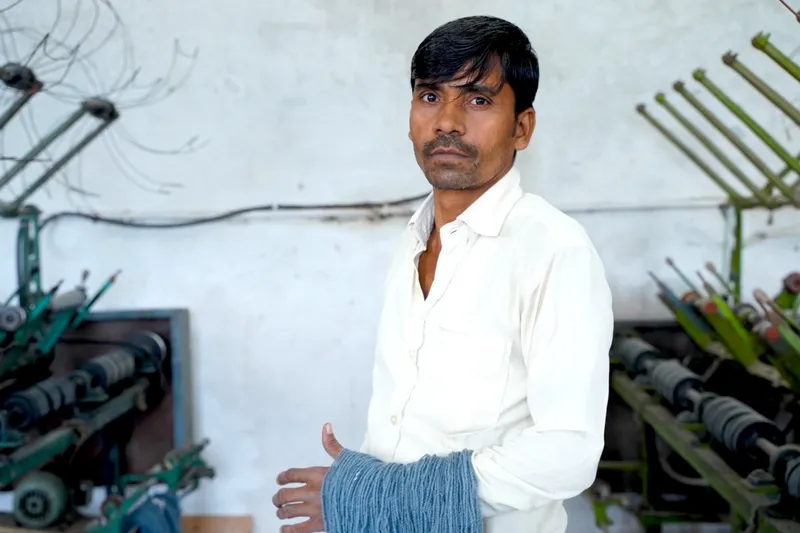
Natural dyes require patience. The mordanting process alone — preparing the fiber to accept and hold the dye — can take several days. The dyebaths are temperature-sensitive and time-sensitive, and the results, while never perfectly standardized, produce a depth and warmth that synthetic dyes approximate but never quite achieve. Anil describes natural dye color as "living color," one that shifts slightly as it ages and develops a patina that only enriches the rug over decades.
His work connects directly to Kapetto's sustainability commitments — natural dyes are inherently lower in environmental impact than their synthetic counterparts, and they reinforce the link between Kapetto's rugs and the material world they come from.
Arjun Yadav: The Apprentice Maker
Arjun Yadav is forty-four and has been weaving for twenty-three years. But his most significant contribution to Kapetto's future may be what he does after his own day's work is done: he teaches. As the workshops' primary master for apprentice training, Arjun has shaped the next generation of weavers over the past decade.
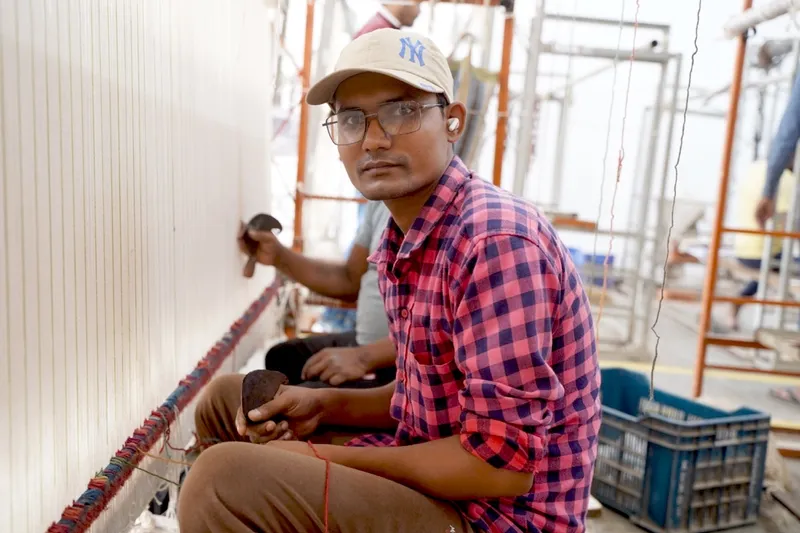
His teaching method is largely non-verbal. He sits beside apprentices, guides their hands, adjusts their posture, corrects their knotting motion through demonstration rather than instruction. It is the same method by which he learned, and he trusts it. "I show them. They watch. Then they try. Then I show them again. After two years, they begin to feel it themselves."
For Kapetto, Arjun's role represents a commitment to the long view. The rugs we make today reflect decades of accumulated knowledge. The rugs made in twenty years will reflect the knowledge he is building now, in quiet workshops, with patient hands and patient teaching.
Mastery as a Living Practice
What unites these seven weavers is not simply their years at the loom — it is their relationship to the craft as something ongoing, always developing, never finished. None of them would describe themselves as having "mastered" anything in the static sense. Mastery, in Bhadohi's weaving culture, is a practice rather than an achievement.
That orientation is precisely what Kapetto looks for in its artisan partners. It is why we invite clients and design professionals to read about all the artisans who contribute to our work, and why we believe the story of a rug — its origins, its makers, the philosophy behind it — is inseparable from the object itself.
When you place a Kapetto cashmere rug in a room, you are placing into that room something that carries the full weight of this knowledge. That is not a marketing claim. It is simply what handmade means, when handmade is done with this degree of seriousness.
To learn more about the traditions, techniques, and culture that make Bhadohi's weavers extraordinary, explore our craft story or visit the artisans page to see more portraits from our workshops.


