

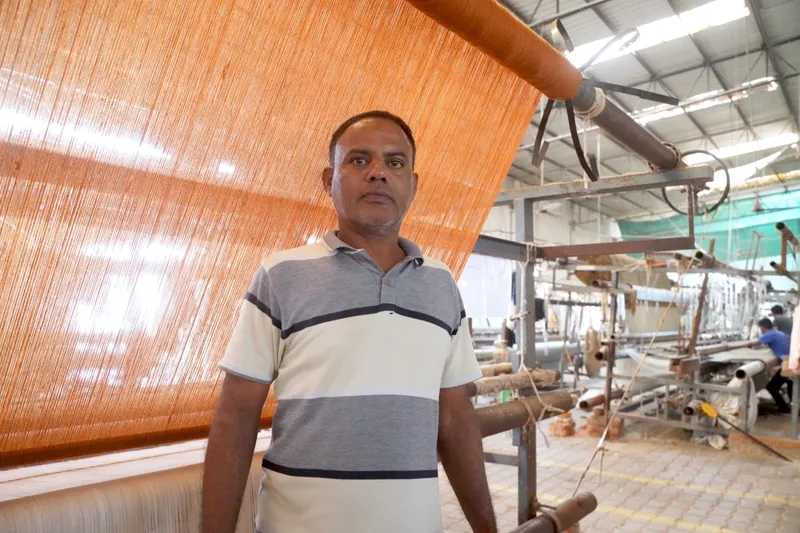
Every Kapetto cashmere rug begins as a conversation between a master weaver and a loom. Not the automated kind — a handloom, strung with cotton warp, standing six feet tall in a workshop in Bhadohi, India. The weaver sits before it for months, tying each knot with practiced hands, building a surface that is, by the time it leaves the loom, something close to irreplaceable. Understanding how that surface comes to be — and how loom knotting differs from traditional hand knotting — is the first step toward understanding why Kapetto cashmere rugs are built to last a lifetime.
What Loom Knotting Actually Means
The terms "hand knotted" and "loom knotted" are often used interchangeably, which creates unnecessary confusion. In practice, every hand-knotted rug is, by definition, made on a loom — the loom is the vertical frame that holds the warp threads taut while the weaver works. The distinction the trade makes between the two terms is more about scale, tooling, and production method than a fundamental difference in craft.
In traditional hand knotting as practiced in Persian and Turkish traditions, a weaver ties knots entirely by hand, using a hook to pull yarn through and around warp threads. The process is deeply manual: each knot is a discrete hand movement, and the weaver relies entirely on muscle memory and pattern reading to maintain consistency across thousands of repetitions.
In loom knotting as Kapetto practices it, the loom itself is engineered to assist the weaver in maintaining perfect tension and alignment. The knots are still tied by hand — there is no automation, no mechanical arm — but the loom frame provides a more stable reference geometry, allowing for greater consistency in pile height and knot spacing. The result is a surface with exceptional evenness, which matters enormously when the fiber in question is as delicate as cashmere.
Why Cashmere Demands a Different Approach
Cashmere is the most demanding fiber in rug making. Each strand is harvested from the downy undercoat of highland goats, combed once a year during the spring molt. A single animal produces between 150 and 200 grams of usable fiber annually. The fiber's extraordinary fineness — typically between 14 and 16 microns in diameter — is what gives cashmere its legendary softness, but it also makes it uniquely susceptible to handling stress during construction.
Wool, by contrast, has a natural crimp and elasticity that makes it forgiving under tension. Silk, though finer, has a rigidity that allows it to hold shape under strain. Cashmere sits in a more complicated middle ground: it is fine enough to distort under uneven tension and soft enough to compress if the pile is set too loosely. This is why the controlled geometry of loom knotting is particularly well-suited to cashmere construction. The loom holds each section of warp at a consistent tension that a purely freehand method would struggle to maintain across a 9-by-12 format.
The pile height question is equally important. Kapetto's cashmere rugs are finished at a pile height of 15mm — a specification arrived at through years of refinement. At 15mm, the pile is deep enough to deliver the sensory luxury cashmere promises underfoot, while remaining dense enough to resist the matting that can plague overly tall piles. Achieving a consistent 15mm across an entire rug requires the kind of geometric control that the loom knotting frame provides.
The Construction Process, Step by Step
The process of making a Kapetto cashmere rug unfolds across several months and involves a small team of specialists working in sequence.
Warp setting. The loom is strung with cotton warp threads at a specific density determined by the desired knot count. For Kapetto's cashmere collection, warp threads are set at a density that allows for approximately 60 to 80 knots per square inch — fine enough to render clean geometric borders, open enough to allow the cashmere pile to bloom fully.
Yarn preparation. Raw cashmere arrives from Inner Mongolia, where the climate produces fiber with exceptional softness and length. It is sorted, cleaned, and spun into yarn at a twist that balances strength with loft. The spinning tension is calibrated specifically for pile work: too tight and the yarn loses its softness; too loose and it will shed excessively in the finished rug.
Color batching. Kapetto works with natural and low-impact synthetic dyes in a closed-loop system that minimizes water waste. Each color is dyed in a single batch for a given rug, ensuring tonal consistency across the entire piece. The Cashmere Caramel, for example, achieves its layered warmth through a two-stage dye process that builds depth across the caramel and amber range.
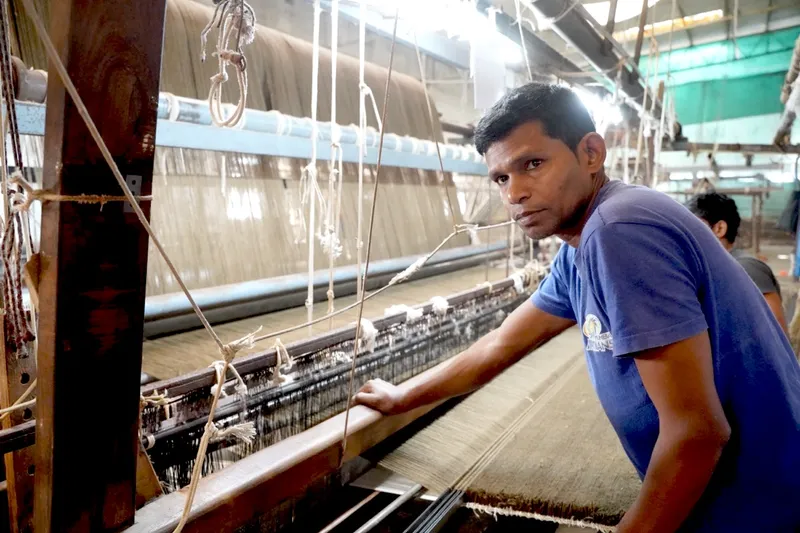
Knotting. The weaver begins at the base of the loom and works upward, row by row. Each knot is tied around two warp threads and cut to the correct length. After every few rows, a weft thread is passed horizontally across the full width of the rug to lock the knots in place. The weaver then uses a comb-like tool to beat the weft tightly downward, compressing the structure and ensuring the pile stands upright and even.
Finishing. Once the rug is cut from the loom, it goes through a series of finishing steps that transform a dense, slightly rough textile into the silken surface Kapetto is known for. The pile is first clipped to an even height using large scissors, then the rug is washed in a mild solution that relaxes the fibers. Finally, it is stretched on a frame to dry, which sets the warp and weft into their final geometry and prevents the warping that can occur if a large rug dries unevenly.
The Artisans Behind Every Piece
No mechanical description of loom knotting fully captures what makes a Kapetto rug exceptional. That quality lives in the people who make them. Our artisans are not factory workers following a script. They are craftspeople who have spent years developing the pattern-reading ability, the tension sensitivity, and the physical endurance that fine rug making requires.
Dablu, our master weaver, has worked with Kapetto's partner workshop in Bhadohi for over two decades. He learned knotting from his father and can assess the quality of a yarn by feel alone. He oversees every cashmere piece from warp-setting to final inspection, correcting tension variations before they compound into visible irregularities.
"Cashmere tells you what it needs. You cannot force it. You have to listen to the tension, feel how the knot sits, and adjust constantly. A rug that looks even was made by someone paying attention at every row."
— Dablu, Master Weaver, Bhadohi
Alongside Dablu, weavers like Ayesha Ansari and Nafisa Begum handle the finer border work that requires the highest levels of pattern consistency. The border of a cashmere rug, where geometric motifs meet the main field, is where technical skill becomes most visible. A misplaced knot in the border cannot be hidden. These sections are assigned only to weavers who have demonstrated the highest accuracy over years of production.
Why Kapetto Chose This Technique
Kapetto could produce cashmere rugs using any number of construction methods. Tufting, for example, is faster and cheaper — a tufting gun drives yarn through a backing in a fraction of the time knotting requires. But tufted rugs are fundamentally different objects. The pile is anchored to a secondary backing rather than integrated into the warp and weft structure, which means it is more likely to delaminate over time and cannot be repaired in the field the way a knotted rug can.
Loom knotting was the choice because it produces the most structurally integrated pile possible with cashmere fiber. Every strand is part of the rug's fundamental architecture. The result is a piece that, cared for properly, will outlast any machine-made or tufted alternative by decades. Learn more about the full range of techniques Kapetto uses across the wool and jute collections.
For designers specifying rugs in the Kapetto Trade Program, this construction detail matters practically as well as aesthetically. A loom-knotted cashmere rug at 15mm pile height can be specified with confidence for master bedrooms, private sitting rooms, and boutique hotel suites where longevity and sensory quality are equally non-negotiable.
Caring for a Loom-Knotted Cashmere Rug
The care requirements for a loom-knotted cashmere rug are straightforward but specific. Vacuum with a low-suction setting and never use a beater bar attachment, which can stress the individual fibers. Rotate the rug every six to twelve months to distribute foot traffic evenly across the pile. For spills, blot immediately with a clean white cloth and address residue with a cold water and mild soap solution, working from the edge of the stain inward. Professional cleaning every three to five years, by a specialist familiar with cashmere textiles, will restore the pile's full loft and extend the rug's life significantly.
A loom-knotted cashmere rug is not a purchase. It is an acquisition — something that joins a home and stays, improving in character and depth as the years pass. That is the promise Kapetto's artisans make with every knot they tie.


