

If you have ever turned a hand-knotted rug upside down, you have seen knot density in its most honest form: row after row of tiny knot tails, packed tightly together or spread more loosely, covering the entire back of the rug in a way that tells you exactly how it was made and, to a trained eye, exactly what it is worth. Knots per square inch — KPSI — is the single most important technical specification in a hand-knotted rug. It governs detail resolution, durability, handle, and price. Understanding it changes how you look at rugs forever.
This guide explains what KPSI means, how to measure it, what different density ranges produce, and how to use this knowledge when evaluating and specifying hand-knotted rugs for your projects.
What KPSI Actually Means
KPSI stands for knots per square inch. It measures how many individual hand-tied knots are packed into one square inch of a rug's surface. Each knot is a loop of yarn wrapped around one or two warp threads (the vertical threads running the length of the rug), then cut to create the pile you see and feel on the face of the rug.
A rug at 40 KPSI has 40 individual knots tied in every square inch of its surface. A rug at 200 KPSI has 200. The higher the number, the more densely packed the knots, and the more labor, time, skill, and material that went into the rug's creation.
KPSI is calculated by counting the number of knots along one horizontal inch (the weft direction) and multiplying by the number of knots along one vertical inch (the warp direction). A rug with 10 horizontal knots and 10 vertical knots per inch has a KPSI of 100. This is why rugs are sometimes described with two numbers — "10 by 10" or "10/10" — rather than a single KPSI figure, though the end result is the same.
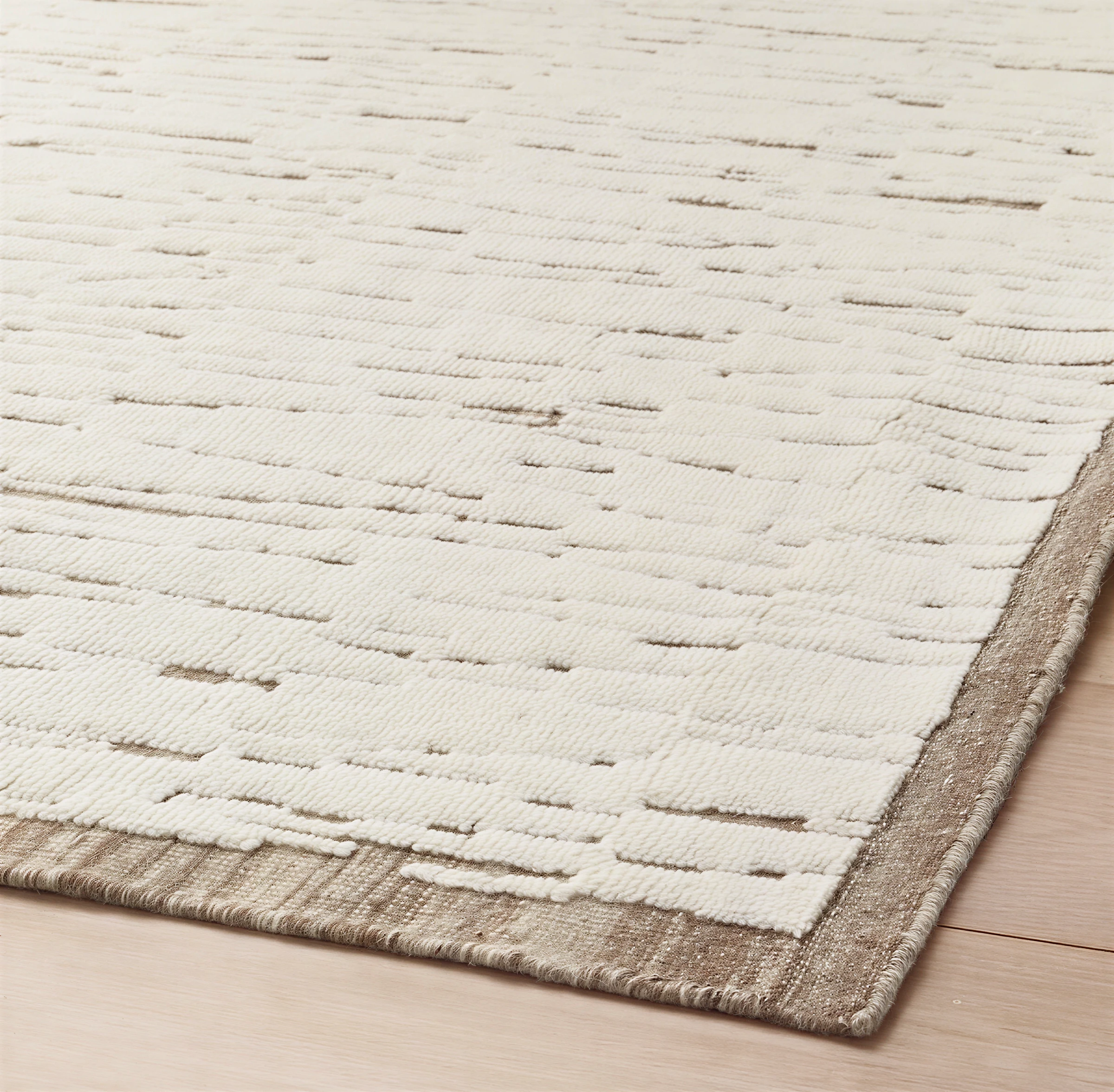
How to Count Knots Yourself
Counting KPSI is straightforward. Turn the rug face down. Take a ruler and mark off a one-inch square anywhere on the back (avoiding the edges, which can be misleading). Count the number of knot tails visible within that square. That number is your KPSI.
For greater accuracy, count three or four different areas of the rug and average the results. Handmade rugs are not perfectly uniform — a slight variation across the surface is normal and actually desirable, as it is evidence of hand production. If every square inch is mechanically identical, it may be a hand-tufted or machine-made rug sold as hand-knotted.
One reliable tell: in a genuine hand-knotted rug, the pattern on the back mirrors the pattern on the face. The knots themselves form the design, not a backing layer added afterward. If the back of the rug is covered in a uniform latex or fabric backing, the rug is not hand-knotted.
Knot Density Ranges and What They Produce
KPSI ranges map loosely onto categories of quality, though material and execution matter as much as density. Here is how to think about the spectrum:
Under 40 KPSI — Tribal and Village Rugs. Low knot density is not a flaw. Traditional tribal and village rugs — Moroccan Beni Ouarains, Afghan war rugs, coarser Persian village weavings — often have KPSI in the 20 to 40 range. The lower density is deliberate: it produces a chunky, deeply textural pile with an organic, handmade feel that is central to the aesthetic. The design vocabulary for these rugs tends to be geometric and bold, suited to the lower resolution of a sparse knot grid. They are extremely durable and often remarkably beautiful.
40 to 80 KPSI — Good Quality Workshop Rugs. This range is where most mid-range hand-knotted rugs sit. The weave is dense enough to render moderately complex patterns with reasonable clarity, and the pile is tight enough to provide good durability and a smooth face. Many contemporary and transitional designs work very well at this density. The handmade quality is still visible and pleasingly apparent.
80 to 150 KPSI — Fine Workshop and Atelier Rugs. This is the range where hand-knotted rugs begin to feel genuinely luxurious. The surface is dense and plush. Complex curvilinear designs can be rendered with real precision. Color gradations become possible. The pile resists crushing even under heavy use. This is also where the time investment becomes significant: a skilled weaver ties 8,000 to 12,000 knots per day, so a 9-by-12-foot rug at 100 KPSI requires approximately 1.5 million knots and can take four to six months to complete.
Kapetto's Kiri hand-knotted rug sits in this range at 100 to 120 KPSI. The density is high enough to render the rug's subtle tonal variations with real fidelity and to produce a surface that feels genuinely dense and substantial underfoot. It is also the density at which a rug, properly cared for, can be expected to last 50 to 100 years without significant deterioration.
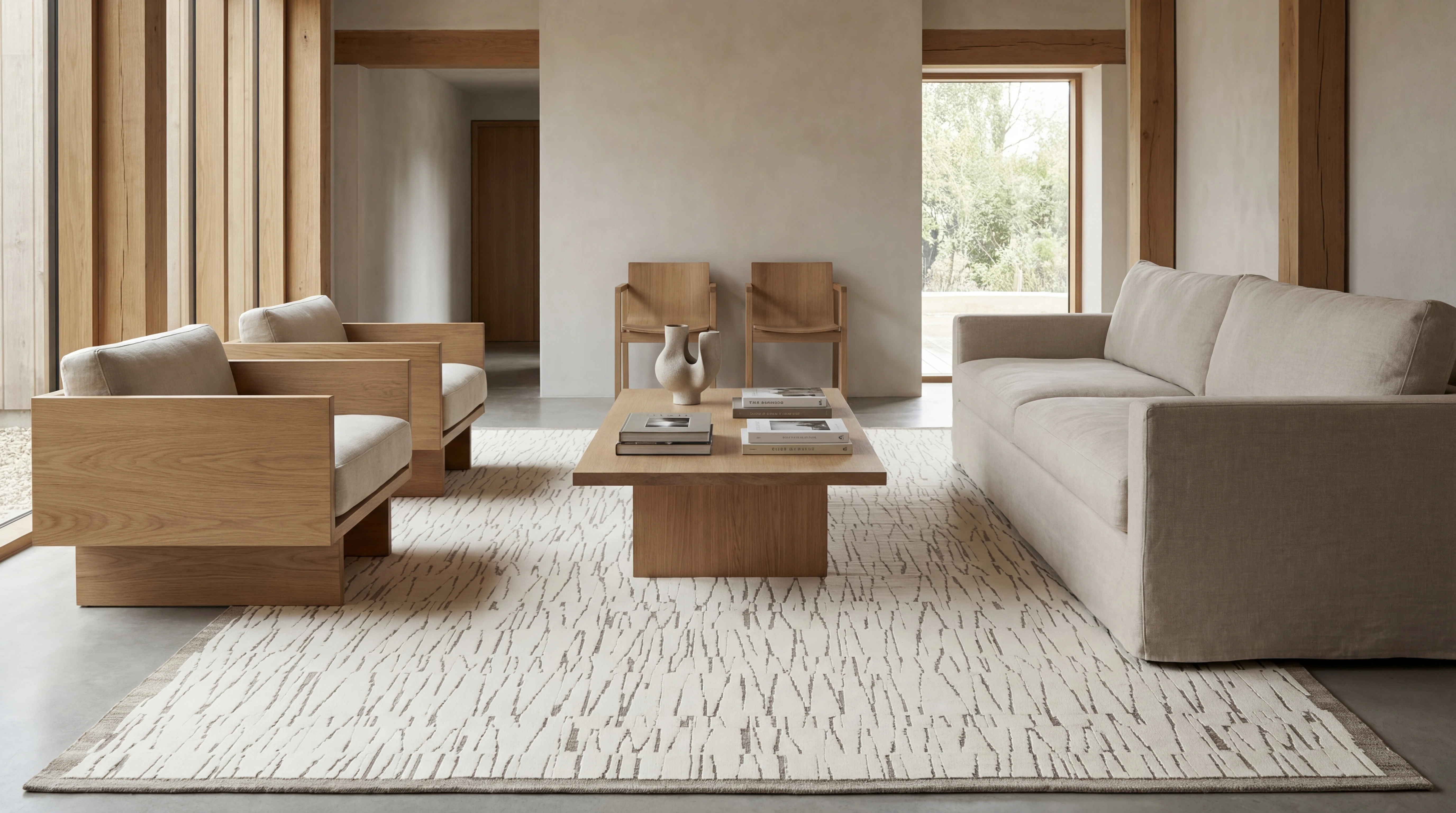
150 to 300 KPSI — Museum-Quality Fine Rugs. At these densities, rug making approaches the limits of what human hands can accomplish. Persian city rugs from Tabriz, Isfahan, or Qom, silk Turkish rugs, and the finest Indian pieces from Jaipur can achieve 200 KPSI or more. A rug at this density may take a single weaver two or three years to complete. The surface is almost impossibly fine, capable of rendering imagery with near-photographic resolution. The cost reflects this: museum-quality fine rugs at the upper end of this range are among the most expensive textiles in the world.
How KPSI Affects Price
Knot density and price are directly linked, though not linearly. Doubling the KPSI more than doubles the price, because each additional increment of density requires proportionally more skilled labor, finer (and more expensive) yarn, and significantly more time.
A simplified way to think about it: KPSI determines the time investment, and time — skilled artisan time — is the primary input in hand-knotted rug pricing. The yarn itself, even for fine materials like cashmere or silk, is a smaller proportion of total cost than the weaving labor. This is why a low-KPSI rug in an expensive material can cost less than a high-KPSI rug in a more ordinary fiber.
It is also why hand-knotted rugs at the finer end of the spectrum are genuinely immune to competition from machine production. No machine can replicate what a skilled artisan produces at 100+ KPSI. The labor itself — irreplaceable and human — is the product.
KPSI and Durability
Higher knot density produces a more durable rug for a straightforward structural reason: denser knots are more tightly constrained by their neighbors. Each knot cannot move independently because the adjacent knots hold it in place. In a looser-knotted rug, individual knots can shift and pull under repeated compression, which is what eventually leads to pile distortion and surface wear.
This is not to say that lower-KPSI rugs are fragile. A well-made tribal rug at 40 KPSI, properly cared for, will outlast several generations of machine-made alternatives. But for high-traffic areas — living rooms, hotel lobbies, corridors — a higher KPSI is worth specifying if longevity is a priority.
KPSI and Design Resolution
Think of KPSI as you would think of image resolution. Low KPSI is like a low-resolution image: individual pixels are visible, fine detail is lost, curves become staircased. High KPSI is like high resolution: fine detail is preserved, curves are smooth, subtle color transitions are possible.
This is why traditional tribal rugs, which tend to have lower KPSI, almost always use bold geometric designs rather than sinuous florals. The geometric vocabulary is suited to the resolution of the grid. Persian city rugs, with their extraordinarily high KPSI, can render organic curvilinear forms, fine arabesques, and even figurative imagery with remarkable clarity because the density of the knot grid is fine enough to approximate continuous curves.
When specifying a hand-knotted rug for a design with complex patterns or subtle color gradations, KPSI matters. A design that requires fine resolution will look muddy and coarse at 40 KPSI and crisp and refined at 100+.
What to Ask When Buying
When evaluating a hand-knotted rug, ask specifically about KPSI (or the horizontal and vertical knot counts that multiply to produce it). Reputable makers will know the answer. Vague responses like "very fine" or "high quality" without a specific figure should prompt further questions.
Also ask about the knotting technique used. The Persian (Senneh) knot, which wraps around one warp thread, allows for finer detail than the Turkish (Ghiordes) knot, which wraps symmetrically around two. Both produce beautiful rugs, but they have different density ceilings and different surface characters.
At Kapetto, we provide specific technical specifications for every rug in our collection. Our trade program for design professionals includes access to detailed technical sheets and sample sourcing support. If you are specifying rugs for a project and want to talk through KPSI, material selection, or lead times, we are here to help.
Understanding KPSI does not require becoming a rug scholar. But knowing what the number means — what it tells you about the hours of human work embedded in the piece, the care of its construction, its likely longevity and appearance over time — transforms the way you look at handmade rugs. They stop being floor coverings and start being what they always were: extraordinary feats of human attention, made one knot at a time.


