

The bedroom rug is among the most intimate objects in an interior. You step onto it barefoot, before the day has properly begun, and the quality of that first contact — the softness or stiffness, the warmth or coldness, the generous or insufficient expanse of it — sets a small but real tone for everything that follows. This is not a philosophical observation. It is a practical one. The rug you choose for your bedroom will be felt, quite literally, every single morning. That frequency of contact makes the material choice, the sizing, and the placement matter more here than almost anywhere else in the home.
This guide covers everything you need to make a confident bedroom rug choice: how to think about placement relative to the bed, how to size correctly for different bed sizes and room configurations, which materials are best suited to the bedroom environment, how to approach color, and how runners and layering can add another dimension to the space.
Placement: The Rug Under the Bed
The central question in bedroom rug placement is how the rug relates to the bed. There are three accepted approaches, each producing a different visual and practical result:
Two-thirds under the bed. The rug extends roughly two-thirds of the way under the bed, with the exposed portion running from the foot of the bed outward and along both sides. This is the most common and most forgiving approach. It works across the widest range of room and bed sizes, creates a generous visual landing pad, and means the rug is protected from furniture compression over most of its surface. For a queen bed, this typically requires at least an 8 by 10-foot rug; for a king, a 9 by 12.
Fully under the bed. The rug extends all the way under the bed and typically beyond all sides. This approach requires a very large rug — often 10 by 14 or larger for a king bed — but creates a cohesive, room-like quality that feels generous and considered. It works best in larger master bedrooms where there is sufficient visible rug at the sides and foot to justify the size.
At the foot of the bed only. A smaller rug (5 by 8 or 6 by 9) placed at the foot of the bed without extending under it. This approach uses the rug as a focal element rather than a ground-level foundation. It works in smaller rooms, works well with bed frames that sit low to the ground (where a rug under the bed would be largely invisible), and is a valid choice when the rug's design is meant to be the visual point. The trade-off is that the rug is not underfoot when stepping out from the sides of the bed.
Sizing by Bed Size
Here is a practical size guide for the two-thirds-under approach, which is the most versatile:
- Twin bed: 5 by 8 minimum, 6 by 9 ideal. Leave at least 18 inches of rug on each exposed side.
- Full/Double bed: 6 by 9 minimum, 8 by 10 ideal.
- Queen bed: 8 by 10 minimum, 9 by 12 ideal. The 9 by 12 is almost always the right choice for a queen in a standard master bedroom.
- King bed: 9 by 12 minimum, 10 by 14 or 12 by 15 for a generous presentation. A king bed on a 9 by 12 can feel slightly mean; if the budget allows, go up.
Before purchasing, tape out the dimensions on the floor. Stand at your habitual exit point from the bed and verify that your feet will land on the rug. This sounds obvious but is often overlooked: the purpose of a bedroom rug is to be underfoot, and checking this in practice prevents a common sizing regret.
Material: Why the Bedroom Changes the Calculation
Material selection in a bedroom is a different conversation from material selection in a living room or dining room. Traffic is lower (almost entirely bare or socked feet, no outdoor shoes, no pets dragging dirt from outside), but the sensory stakes are higher. The bedroom is where material luxury is most immediately felt. This changes the calculus in favor of materials that prioritize softness and warmth over durability.
Cashmere is, by a significant margin, the ideal bedroom rug material. The same properties that make cashmere extraordinary as a garment fiber — its exceptional softness, its thermal regulation, the warmth it emanates without weight — translate directly to the rug context. Stepping onto a cashmere pile at 15mm is a qualitatively different experience from any other floor surface. It is also temperature-regulating in both directions: warm in winter, cool in summer, in a way that synthetic-fiber rugs simply cannot replicate.
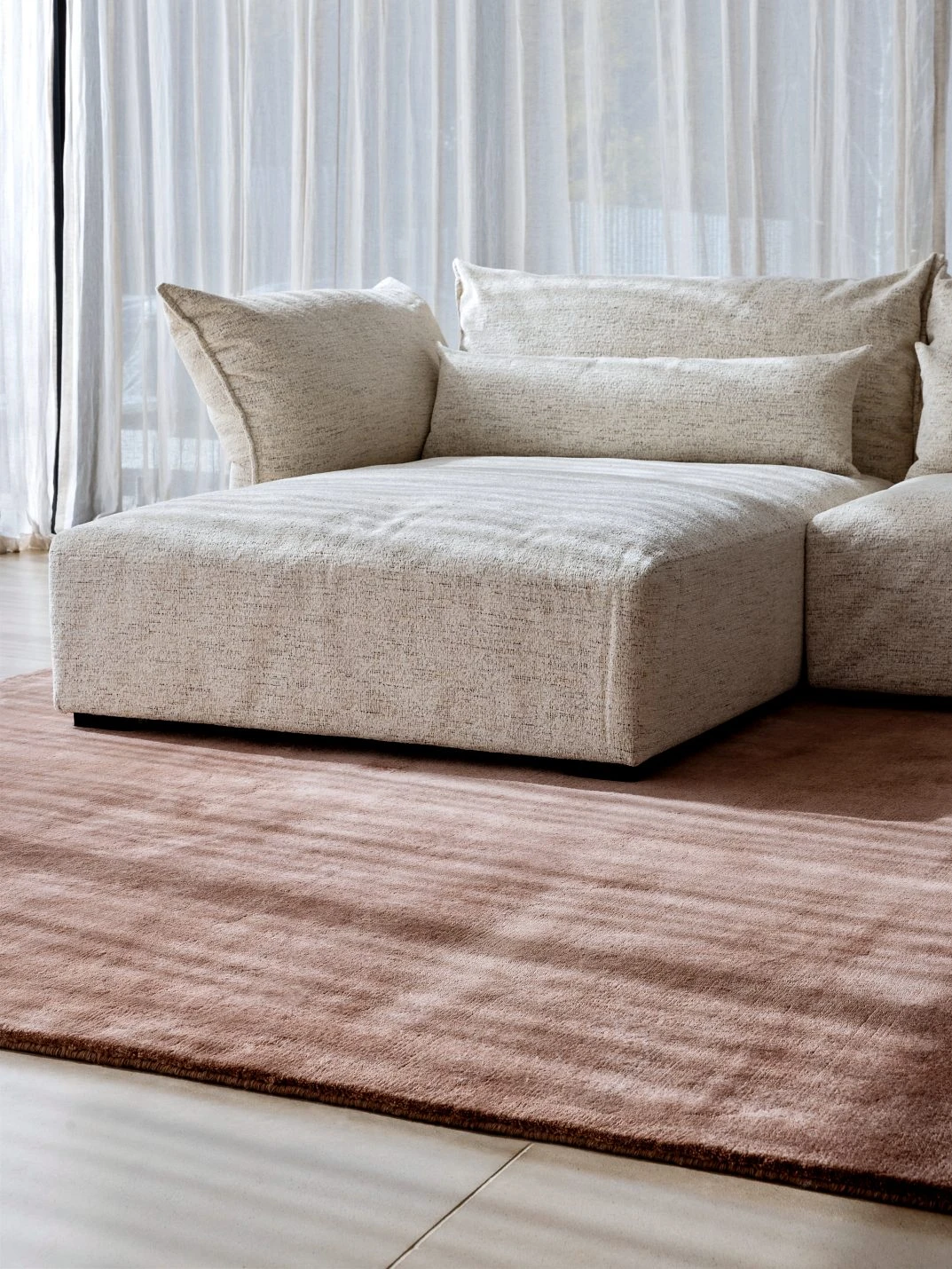
Kapetto's cashmere collection spans four colors specifically chosen for bedroom environments: Caramel (warm, grounding), Latte (soft, golden-neutral), Rose (warm blush, deeply flattering in soft light), and Lagoon (soft blue-green, serene and calming). All are loom-knotted at 15mm pile height from the highest-grade cashmere fiber.
Wool at a higher pile height is an excellent alternative when cashmere is not within scope. New Zealand wool in a loom-knotted or hand-knotted construction offers good softness, natural warmth, and the resilience to maintain its pile height over time. Our Nami wool rug works beautifully in bedrooms where the design calls for a more textural, less pristine surface.
Natural fiber rugs (jute, sisal, seagrass) are generally not well-suited to bedrooms. They can be coarse underfoot when barefoot, they lack the warmth that makes a bedroom rug worth having, and they can be difficult to clean when accidentally dampened. Use natural fiber in rooms where the visual texture is the point and barefoot comfort is not the primary concern.

Color for Bedrooms: Serene, Not Sterile
Bedroom color psychology has been written about extensively, and the consensus is consistent: the bedroom benefits from colors that read as restful. This means avoiding high-contrast patterns, highly saturated hues, or anything that creates visual energy when you are trying to wind down.
That said, restful does not mean colorless. Some of the most beautiful bedroom interiors use quite saturated tones — deep terracotta, soft forest green, warm indigo — precisely because these colors, at the right value, are enveloping rather than stimulating. The key is value (lightness to darkness) more than hue: mid-to-dark values in warm-toned hues tend to read as cocooning and serene.
For the rug specifically, the most enduring choices are those that work across different lighting conditions. A bedroom rug will be seen in morning light, evening light, lamplight, and darkness. Warm neutrals perform consistently across all of these. Our cashmere caramel and latte tones are designed to be flattering in candlelight and calm in daylight — a combination that is harder to achieve than it sounds.
For rooms with a more deliberate color strategy, the rug color can respond to the room's dominant palette. A bedroom with warm terracotta walls and linen upholstery is elevated by a cashmere rose or caramel. A room with cool, quiet whites and raw wood benefits from a lagoon or latte that introduces warmth without competing.
Runners and Layering
A single large rug under the bed is the most common approach, but it is not the only one. Two runners — one on each side of the bed — are a valid and elegant alternative, particularly in rooms where a large rug would overwhelm a smaller space or where the bed is positioned close to a wall.
Standard runner proportions for beside-the-bed placement are 2.5 by 8 or 3 by 10 feet, running parallel to the bed's length. The runner should extend slightly beyond both the headboard and foot of the bed so it reads as intentional rather than undersized. Two runners in a consistent material create a clean, symmetrical aesthetic; two runners in different but harmonious materials (say, a jute runner paired with a small cashmere piece at the foot of the bed) can add layered interest in a larger room.
Layering a smaller, more luxurious rug over a larger base rug is also increasingly common in bedroom design. A large natural fiber rug as the ground layer with a cashmere piece layered over it at the foot of the bed creates a moment of material luxury precisely where it is most felt, without requiring a full cashmere rug across the entire floor area. This approach is practical as well as beautiful: the layered piece can be rotated or replaced independently.
Caring for a Bedroom Rug
Bedroom rugs experience a specific kind of wear — low abrasion but daily compression, occasional moisture (from wet feet after a shower, or spilled water from a bedside glass), and accumulation of fine dust that settles from the room environment. The care routine is accordingly simpler than for a high-traffic living room rug but still worth maintaining.
Rotate the rug 180 degrees every six to twelve months to ensure even light exposure and even wear at the sides of the bed. Vacuum regularly (for cashmere and fine wool, use a suction-only setting without the beater bar, which can stress fine fibers). For spills, blot immediately with a clean white cloth from the outside of the spill inward; do not rub. Professional cleaning every three to five years will refresh the pile and remove accumulated dust that routine vacuuming misses.
A quality felt rug pad is important even in a bedroom. It prevents shifting, protects the rug's foundation, and adds a layer of cushioning that makes the surface noticeably softer underfoot. For cashmere rugs specifically, a felt pad (rather than rubber) is recommended, as it allows the fiber to breathe.
The bedroom rug, chosen with care, becomes one of those quiet pleasures that makes a home feel genuinely considered. It does not announce itself. It simply does its work, morning after morning, in the most personal room of the house. Getting it right is worth exactly this kind of attention.
To explore the full Kapetto cashmere range or to request samples, visit our cashmere collection. For designers specifying for client projects, our trade program provides access to sampling, extended lead-time options, and dedicated project support.

