

A hand-knotted rug begins as a design on paper and ends, months later, as a dense textile capable of lasting a century. Understanding how rugs are made — genuinely understanding it, not just knowing that "someone ties knots" — changes how you see every piece you ever walk into a room. It explains why a fine hand-knotted rug costs what it does, why it behaves differently from every machine-made alternative, and why the people who produce it are rightly considered artisans rather than workers.
The hand-knotted rug process has not changed in its essentials for five hundred years. The tools are simple. The materials are natural. The differentiating variable is the human being at the loom, and the years of practice they bring to every knot.
Step One: Design and Graph Preparation
Before a single knot is tied, the design must be resolved with complete precision. A hand-knotted rug is essentially a pixel image, where each knot is a single colored unit. The designer translates the pattern into a graph called a naksha, where each square on the grid represents one knot and carries a color code. For a rug with 100 knots per square inch and a finished size of 9 by 12 feet, this graph contains approximately 1.5 million individual cells.
At Kapetto, design development involves close collaboration between our creative team and the master weavers who will actually execute the work. A design that looks beautiful on screen may be technically impossible at a given knot density, or may require color transitions that only an experienced weaver can execute without banding. The naksha is not finalized until both the designer and the master weaver have approved it.
Step Two: Fiber Selection and Preparation
The character of a finished rug is inseparable from the quality of its fiber. This is where the most consequential decisions in the entire process are made.
Wool for fine rug making comes primarily from New Zealand and Australian Merino flocks, prized for their long staple length, natural crimp, and exceptional whiteness. The crimp gives wool its resilience — the ability to spring back after compression — while the whiteness ensures that dyed colors are pure and unmuddied. At Kapetto, we use New Zealand wool for the Wool collection, selecting fleece with a fiber diameter under 20 microns for the softest possible hand.
Cashmere is a different proposition entirely. It comes from the downy undercoat of Changthangi goats raised at altitude in the highlands of Central Asia, where the cold climate produces the finest, most insulating fiber in nature. Each animal yields only 150 to 200 grams of usable cashmere per year, making the material both precious and inherently limited in supply. The raw cashmere is combed, not shorn, from the animals in spring, then sorted by hand to remove coarser guard hairs.
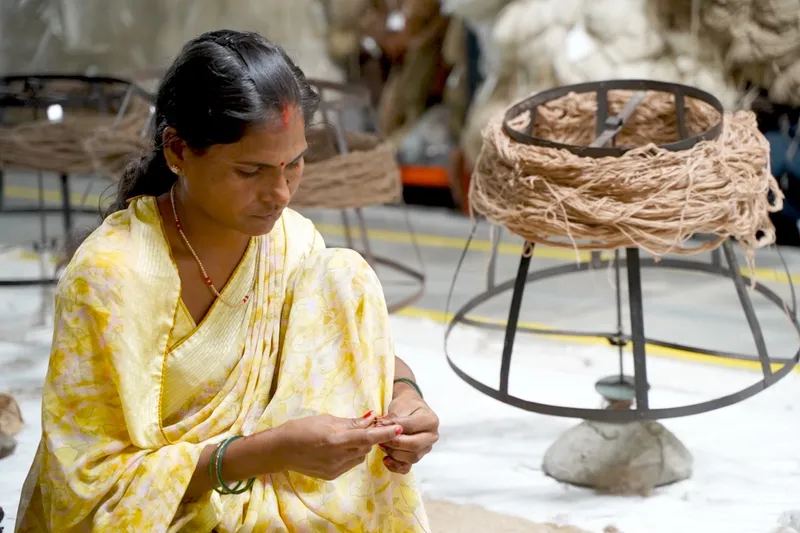
Raw fiber is cleaned, carded to align the individual fibers, and spun into yarn. The twist of the yarn — tight for durability and definition, looser for softness and sheen — is a parameter the master spinner sets based on how the yarn will be used: pile knots or warp threads.
Step Three: Dyeing
Dyeing is one of the most technically demanding stages of the entire hand-knotted rug process, and one of the most visually consequential. The colors you see in a finished Kapetto rug are the product of dye chemistry, water chemistry, temperature control, and the accumulated instinct of a dye master who has spent years learning how a given fiber absorbs color.
Natural dyes are used for specific effects. Indigo produces blues of unmatched depth. Madder root yields warm reds that shift subtly in different light. Pomegranate rind creates golds and mustards that no synthetic dye can quite replicate. Natural dyes have a characteristic quality: they absorb unevenly at the micro level, creating slight variations within a single color field that give the rug a visual richness synthetic uniformity cannot match. This quality is called abrash, and in fine rugs it is considered a mark of authenticity rather than imperfection.
Where synthetic dyes are used — as they are in most contemporary production for color consistency and lightfastness — Kapetto specifies only OEKO-TEX certified dye lots. This ensures no harmful substances enter either the finished rug or the workshop environment.
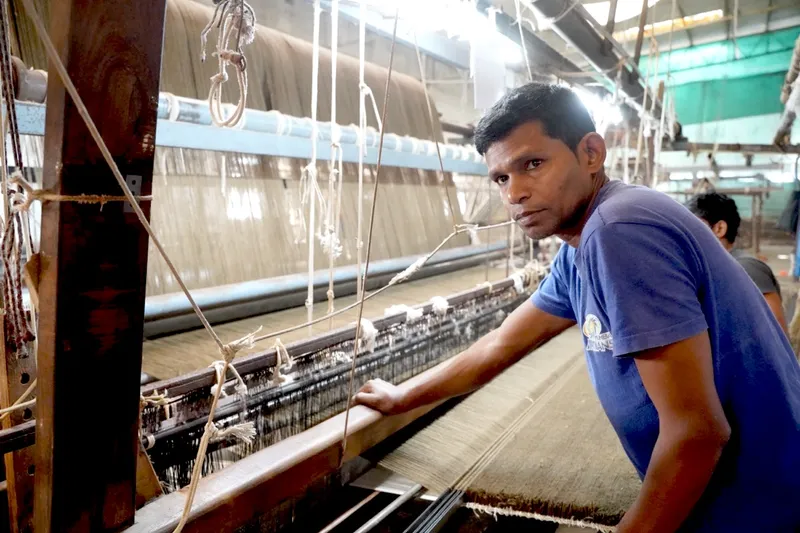
After dyeing, yarn hanks are washed, dried in the open air, and checked against the naksha color codes before weaving begins. Any lot that does not match precisely is re-dyed. This quality check sounds simple; in practice, it requires the kind of color discrimination that takes years to develop.
Step Four: Warping the Loom
The loom is the structural framework of the entire rug. Before a single pile knot is tied, warp threads must be strung vertically across the loom frame with precise and consistent tension. These cotton or wool warp threads form the structural backbone of the rug; the pile knots wrap around them, and the weft threads pass through them horizontally after each row of knots to lock the work in place.
Warping a loom for a 9-by-12-foot rug at 100 knots per square inch requires threading approximately 1,080 individual warp threads with consistent tension across the full width. If the tension varies, the finished rug will buckle or ripple when it comes off the loom. An experienced warper can tension a loom by feel, running a thumb across the threads and making micro-adjustments until the whole surface resonates evenly.
Step Five: Knotting — The Work That Defines Everything
Knotting is the stage that separates a hand-knotted rug from every other type of floor covering. Each knot is tied individually around two adjacent warp threads, cut at a consistent height, and packed down with a comb before the next row begins. A skilled weaver reads the naksha graph constantly, switching colors according to the pattern while maintaining the physical consistency that makes the finished surface even and tight.
The two primary knot types used in Bhadohi are the Persian (Senneh) knot and the Tibetan knot. The Persian knot wraps asymmetrically around one warp thread and passes under the adjacent one, allowing for finer resolution and higher knot counts — it is the knot used in Kapetto's Kiri collection. The Tibetan knot, used in loom-knotted cashmere production, creates a distinctive looped structure before cutting that produces a notably soft and even pile.
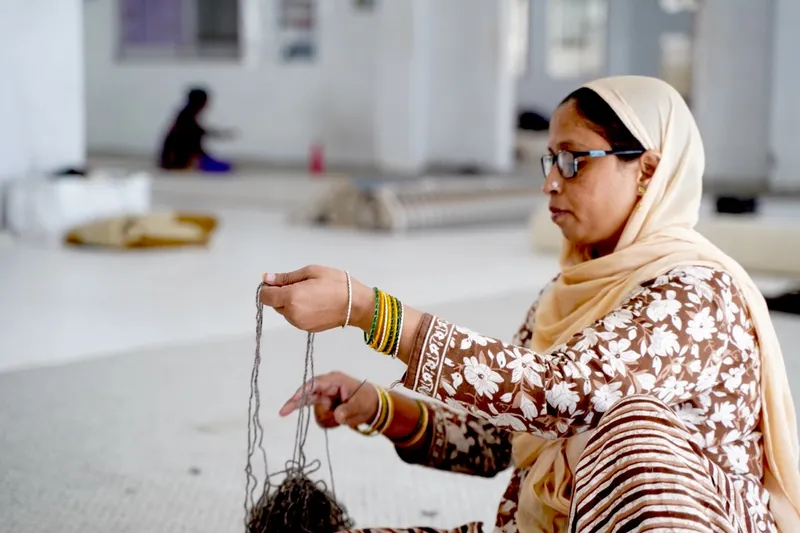
Speed and accuracy develop together over years of practice. A novice weaver might tie 3,000 to 4,000 knots per day; an experienced master achieves 10,000 to 12,000. The difference is not haste. It is the elimination of hesitation — each motion becoming so practiced that the hand does not need to pause between the reading of the naksha and the execution of the knot.
A typical Kapetto rug at a 9-by-12-foot size and 100 KPSI takes one weaver four to six months of full-time work to complete. Some of our cashmere pieces, at their 15mm pile height and precise finishing requirements, take longer.
Step Six: Washing and Stretching
When the rug comes off the loom, it is stiff, dense, and carries residual lanolin from the wool as well as dye remnants. The first wash is a full immersion in water — in Bhadohi, traditionally in the rivers nearby — with gentle agitation to open the fibers and remove impurities. This wash also triggers a natural relaxation in the wool fibers: the pile softens and begins to bloom, the colors settle into their final register, and the texture the designer intended begins to emerge.
After washing, the rug is stretched on outdoor frames and left to dry flat in the sun. The stretching is critical. A rug that dries without tension will set into whatever shape it dried in, potentially introducing a bow or wave that no amount of later effort can fully correct. Experienced stretchers check the geometry of each piece with measuring cords and adjust the frame accordingly before the rug is pinned.
Step Seven: Clipping, Carving, and Finishing
The final transformation happens in the hands of the finishers. Once dry, the rug undergoes pile clipping — a careful, even cut across the entire surface to bring the pile to its specified height. For a cashmere rug at 15mm, this requires consistent scissor pressure across a surface that may be 108 square feet. The finisher works in long, overlapping strokes, checking the height constantly against a gauge.
Carving is an optional but often spectacular step, particularly for rugs with distinct pattern elements. The finisher uses pointed scissors to sculpt the pile around design motifs, creating depth and shadow effects that make the pattern appear almost three-dimensional. Carving a complex rug adds a day or more to the finishing process but transforms the visual impact of the finished piece.
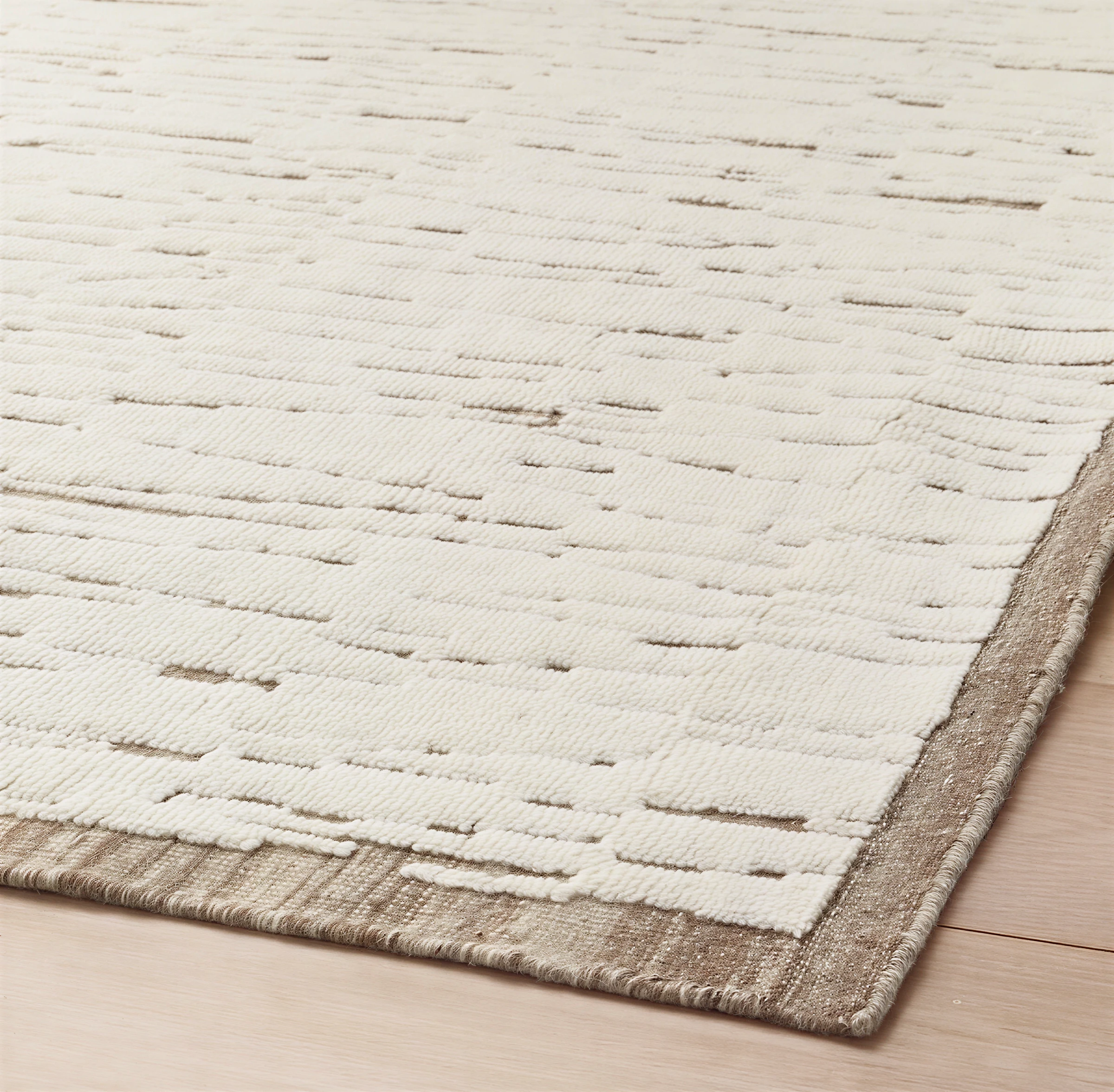
The final quality inspection checks every dimension and specification: pile height, color accuracy against the approved sample, knot consistency at the edges, fringe alignment, and overall geometry. At Kapetto, this inspection happens on-site in Bhadohi before the rug is released for packing. Any piece that does not meet specification is returned for correction.
The Timeline for a Hand-Knotted Rug
The full journey from fiber selection to finished rug typically takes the following time:
- Design and naksha preparation: 2 to 4 weeks
- Fiber preparation and dyeing: 1 to 2 weeks
- Warping: 2 to 3 days
- Knotting: 8 to 24 weeks depending on size and knot density
- Washing, stretching, and drying: 3 to 5 days
- Finishing and quality check: 3 to 7 days
For standard sizes, Kapetto typically ships within 4 to 8 weeks because we maintain production in progress at all times. Custom sizes follow a 20 to 30 week lead time from design approval.
Why the Process Cannot Be Rushed
Every stage of the hand-knotted rug process has a natural pace. Dyeing cannot be accelerated without risking uneven color penetration. Knotting cannot be sped up without compromising consistency. Washing and stretching require the time for fibers to fully relax and set. Finishing demands the patience to check every square foot.
This is not inefficiency. It is the fundamental character of the craft. A hand-knotted rug made properly takes as long as it takes, and the result is a piece that will still be beautiful in a hundred years. No shortcuts lead to that outcome.
If you are exploring hand-knotted options for a project, our Trade Program provides access to our full production specifications, sample memo service, and direct consultation with the Kapetto design team. For an overview of our craft philosophy and the techniques we use across different collections, the Craft page covers each in detail.
Frequently Asked Questions
How is a hand-knotted rug different from a hand-tufted rug?
A hand-knotted rug has each knot individually tied around the structural warp threads; the pile is integral to the foundation. A hand-tufted rug is made by punching loops of yarn through a pre-fabricated backing using a tufting gun, then applying a secondary backing with adhesive to hold the pile in place. Hand-knotted rugs are more durable, more valuable, and structurally superior. Hand-tufted rugs are faster to produce and significantly less expensive.
How long does it take to make a hand-knotted rug?
For a 9-by-12-foot rug at 100 knots per square inch, expect four to six months of weaving time alone. From fiber selection to finished piece, the full process is typically five to eight months for a single piece.
Does a higher knot count always mean better quality?
Higher knot count enables finer pattern resolution and generally produces a more durable surface. But the appropriate knot density depends on the design intent. A boldly patterned geometric rug may look exactly right at 60 KPSI, while a detailed floral or abstract gradient pattern needs 100 KPSI or more to render cleanly. Knot count is a specification, not a universal quality indicator.
How do I know if a rug is genuinely hand-knotted?
Turn the rug over. In a hand-knotted rug, the pattern on the back mirrors the front with the same clarity and detail, because the knots penetrate the entire thickness of the foundation. If the back shows a grid of adhesive and a fabric backing, the rug is hand-tufted. If the pattern is blurry or absent on the back, it is machine-made.


