

In 1949, a Soviet archaeologist working in the frozen Pazyryk Valley of Siberia pulled back a layer of permafrost and found something that would rewrite the history of human craft. Buried with a Scythian chieftain around 500 BCE, the Pazyryk carpet emerged almost perfectly preserved — its pile still soft, its colors still vivid, its symmetrical border of deer and horsemen still breathtaking in their precision. At 36 knots per square inch across a 6-by-6.5-foot surface, it was not a primitive attempt at weaving. It was a masterwork. Someone, somewhere, had already been making rugs for a very long time before that chieftain was buried with his finest possession.
The history of rugs is the history of human civilization in miniature: nomadic peoples turning necessity into beauty, empires using textiles as a language of power, trade routes carrying both goods and ideas across continents, and individual artisans passing accumulated knowledge down through generations with the same care they gave to knotting each individual thread.
The World's Oldest Rug and What It Tells Us
The Pazyryk carpet remains the oldest surviving pile rug, but its sophistication suggests that rug making predates it by centuries, perhaps millennia. The technique required to produce it — wrapping individual knots around vertical warp threads at precise, regular intervals — is not something that springs fully formed from a single invention. It accumulates. The Pazyryk carpet is the evidence of a mature tradition, not a first attempt.
What the Pazyryk tells us, beyond the bare fact of its existence, is that rug making was from its earliest days a practice that blended utility with high artistry. The carpet was functional: it insulated against cold ground and muffled sound in a tent. But its elaborate design — repeating rosettes, mythological animals, precise geometric borders — was clearly meant to communicate status, taste, and cultural identity. This dual nature, useful and beautiful, practical and symbolic, has defined the finest rugs ever since.
The Persian Empire and the Golden Age of Carpet Weaving
If the Scythian steppes were the birthplace, Persia was where rug making came of age. The Achaemenid court of Cyrus the Great (sixth century BCE) is recorded in Greek and Roman sources as lavishing extraordinary carpets on palace floors and receiving them as tribute from vassal states. Persian carpets became so synonymous with luxury that Alexander the Great reportedly stood on them after conquering Persepolis — a symbolic act of claiming Persian civilization as his own.
The Safavid dynasty (1501 to 1736 CE) represents the absolute apex of Persian carpet making. The royal workshops at Isfahan, Tabriz, and Kashan produced rugs of staggering complexity: the Ardabil carpet, woven around 1540 and now held at the Victoria and Albert Museum in London, contains approximately 26 million knots tied at a density of roughly 520 per square inch. Two professional weavers working at this density would have needed over three years to complete it. It is not a floor covering. It is a cosmological map, a garden of paradise rendered in wool and silk, a statement about the nature of beauty itself.
The Safavid period also established the basic vocabulary of classical Persian design — the central medallion, the arabesque, the floral lattice, the directional prayer niche — that would influence rug making across the Islamic world and, through trade, eventually across all of Europe and Asia.
The Silk Road and the Spread of a Craft
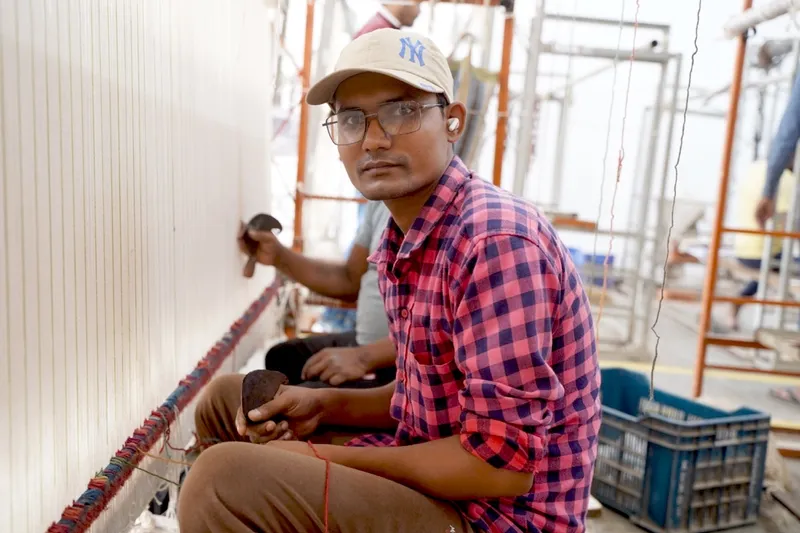
The Silk Road did not merely carry bolts of Chinese silk westward. It carried ideas. As merchants, pilgrims, and diplomats moved between China, Central Asia, Persia, the Levant, and Europe, they took weaving techniques with them. Anatolian rug making developed its own distinct grammar of bold geometric forms. The Caucasus evolved an angular, almost architectural aesthetic. North African Berber weavers developed flat-weave kelim traditions that solved the same problem — how to make a warm, beautiful surface from thread — with a completely different structural logic.
Each regional tradition was a response to its local conditions: the wool available from local sheep, the natural dyes found in local plants, the cultural symbols most meaningful to the community, and the particular aesthetic preferences of the patrons who commissioned and purchased the work. Rug making was never a monolithic tradition. It was a family of practices, related but distinct, sharing a common ancestor and diverging beautifully over time.
Mughal India and the Birth of Indo-Persian Weaving
When the Mughal emperor Akbar the Great established royal carpet workshops at Agra, Lahore, and Fatehpur Sikri in the late sixteenth century, he was doing something more than furnishing a palace. He was seeding a tradition that would eventually give rise to the modern Indian rug industry — and, centuries later, to the workshops of Bhadohi.
Akbar imported Persian weavers to train local craftsmen, and what emerged was a fusion tradition that blended Persian formal sophistication with Indian sensibility: richer color, more naturalistic floral motifs, a warmth and lushness that distinguished Indian work from its Persian forebears. The Mughal court's patronage elevated carpet weaving to a court art of the highest order. Emperors commissioned rugs the way European monarchs commissioned portraits — as a form of self-expression and political communication.
You can read more about this chapter of the story in our deep dive on the Mughal legacy in Indian rug making.
Bhadohi: Where Tradition Became Industry
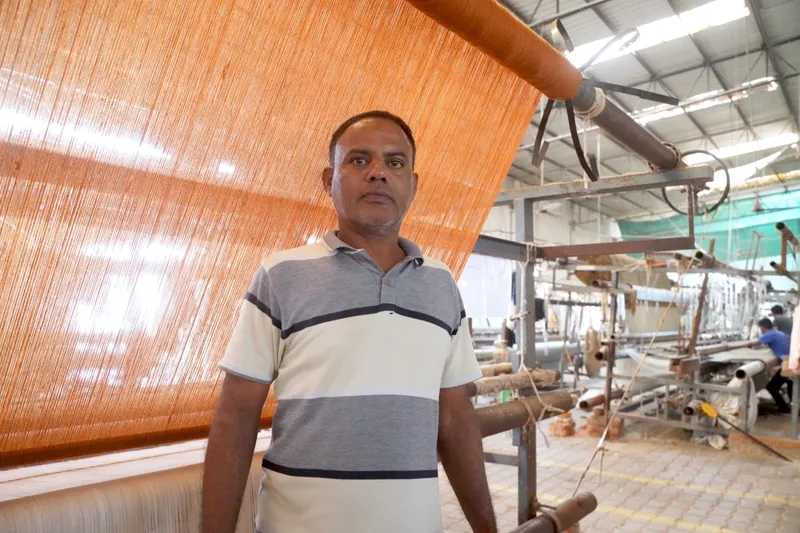
The town of Bhadohi in eastern Uttar Pradesh is today known as the Carpet Capital of the World — a title earned not by accident but by the steady accumulation of skill across generations. The Mughal workshops at Agra lay not far away. As royal patronage ebbed and flowed over the centuries, knowledge dispersed into communities. Weavers established themselves in villages across the Mirzapur-Bhadohi belt, where the climate suited the craft and the community could sustain it.
In the nineteenth century, European demand for "Oriental" rugs created the commercial infrastructure that transformed cottage weaving into a regional industry. Export houses established in Mirzapur connected Bhadohi weavers to the drawing rooms of London, Paris, and New York. The craft that had served Mughal emperors now furnished the homes of Victorian merchants — and the knowledge that made it possible remained embedded in the hands and minds of local artisans.
Today, Bhadohi produces roughly 85 percent of India's handmade rug exports. The tradition Akbar seeded four centuries ago now sustains hundreds of thousands of families. You can read more about what makes this region remarkable in our article on Bhadohi as the carpet capital of the world.
The Twentieth Century: Disruption and Survival
The industrial revolution and the invention of power looms in the nineteenth century posed an existential challenge to hand weaving. Machine-made carpets could be produced at a fraction of the cost and in a fraction of the time. For a brief, uncomfortable period, it seemed possible that the handmade rug would become purely a museum artifact.
It did not. Several forces conspired to preserve hand weaving as a living practice. First, there was quality: machine looms could approximate the appearance of hand-knotted rugs but could not replicate their density, their durability, or the subtle irregularity that gives handmade work its warmth and life. Second, there was connoisseurship: collectors, designers, and homeowners who had experienced fine hand-knotted rugs recognized immediately that machine alternatives were not equivalent goods. Third, and most importantly, there were the communities of weavers themselves, for whom the craft was not merely employment but identity — and who found ways to adapt without abandoning what made their work irreplaceable.
Modern Artisans and the Living Tradition
The most important thing to understand about the history of rug making is that it has not ended. It is not a story to be read in a museum. Every time an artisan sits at a loom in Bhadohi and ties a knot, they are adding a sentence to a 2,500-year-old text.
At Kapetto, we work directly with master weavers whose families have been making rugs for generations. Our hand-knotted Kiri rug is produced at 100 to 120 knots per square inch — a density that connects it directly to the fine rug making traditions of Persian and Mughal workshops. Our cashmere collection represents the meeting of ancient technique with contemporary material: the same structural vocabulary that gave us the Pazyryk carpet, expressed in one of the world's rarest and finest fibers.
The artisans who make our rugs are not recreating a dead tradition. They are continuing a living one. To learn more about the people behind the work, visit our artisans page, or read about the craft techniques that have been refined over centuries and remain, at their core, unchanged.
"A handmade rug is one of the few objects you can own that connects you directly to thousands of years of human making. Every knot is a deliberate act. There is nothing accidental in it."
What History Teaches Us About Choosing a Rug
The Pazyryk carpet survived 2,500 years because it was made with extraordinary care and the finest materials available. Its makers did not cut corners. They tied each knot as if they knew it would outlast them — because they did know. The finest rugs have always been made with posterity in mind.
This is the standard Kapetto holds itself to. Not because we are trying to compete with ancient Persia or the Mughal court, but because the tradition demands it. When you buy a handmade rug made with the same techniques, the same commitment to material quality, and the same human attention that has defined the finest rugs for two and a half millennia, you are not buying a floor covering. You are buying a piece of that story.
And the story, it turns out, is still being written.


