

The question of whether handmade rugs are worth the investment is, at its core, a question about how you think about value. If value means the lowest upfront price, then a machine-made rug will always appear to win. If value means the lowest cost per year of use, the highest quality over time, and the least environmental burden per decade of ownership, the math shifts considerably. This article works through all of it: cost analysis, durability, appreciation, environmental cost, and the dimension of value that numbers cannot quite reach.
The Cost-Per-Year Argument
The most honest way to compare a handmade and a machine-made rug is not to compare their price tags but to divide those price tags by the realistic number of years of useful life each will deliver.
A machine-made rug in the mid-price range — say, $800 to $1,500 for a 9-by-12-foot piece — has a realistic useful life of five to ten years in a normally occupied room. After that, the pile has crushed, the colors have faded unevenly, and the backing has begun to delaminate. Most end up in a landfill. At $1,200 over eight years, that is $150 per year.
A hand-knotted or loom-knotted rug from a reputable maker, at $4,000 to $8,000 for the same 9-by-12 format, has a realistic useful life of 50 to 100 years. Antique Persian and Caucasian rugs from the 19th century are not museum curiosities — they are still in active daily use in homes around the world. At $6,000 over 60 years, that is $100 per year. The handmade rug costs less annually, and at the end of its life it retains value as a collectible object, potentially more value than it carried when new.
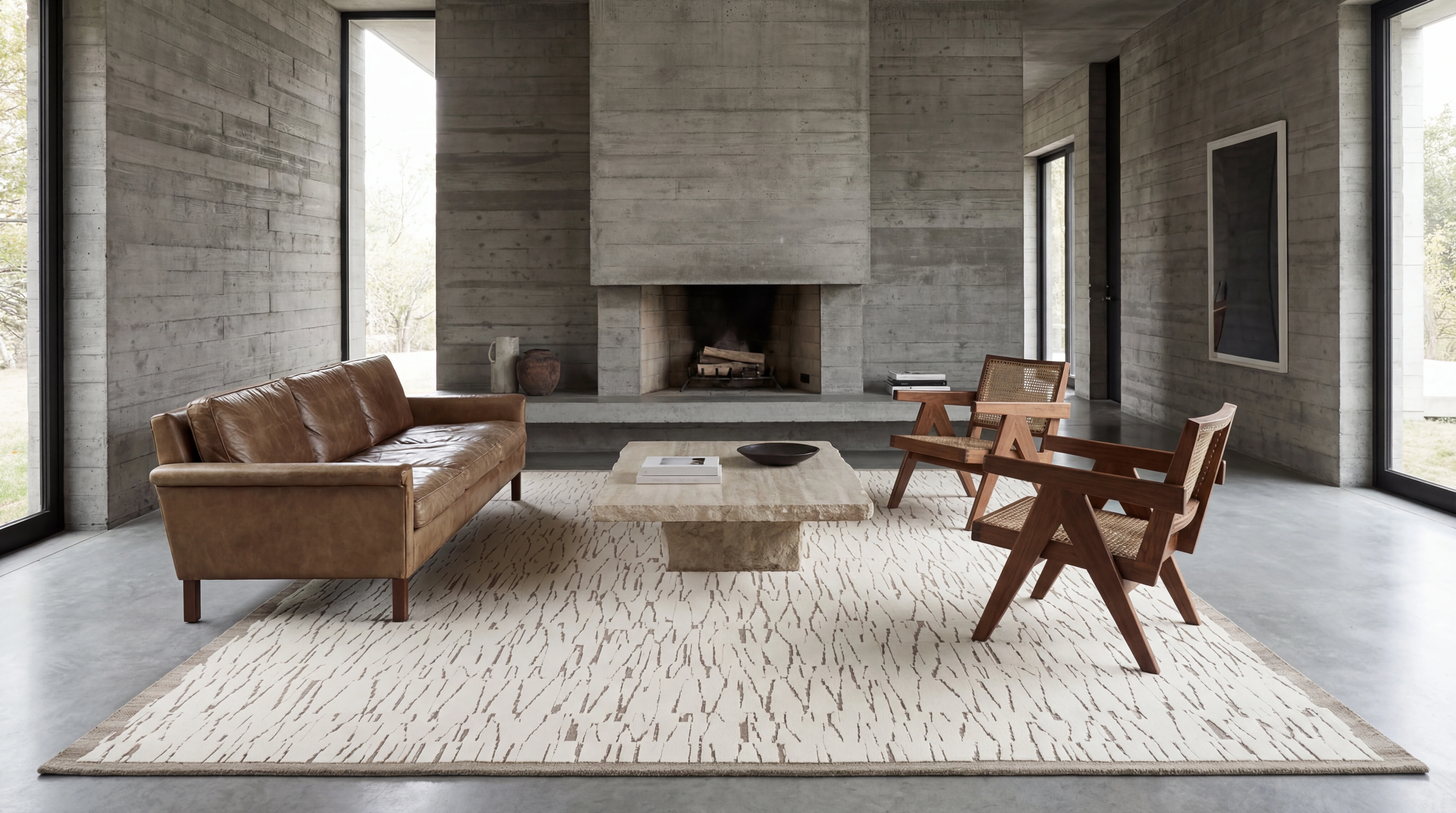
The cost-per-year comparison is not hypothetical. It is how every informed institutional buyer — five-star hotels, museum collections, private estates — has always evaluated floor coverings. The upfront cost is a barrier that dissolves when the denominator is long enough.
Why Hand-Knotted Rugs Are Expensive
Understanding the price of a hand-knotted rug requires understanding where that price goes. It is not margin. It is labor and time, which are the same thing.
A skilled weaver ties between 8,000 and 12,000 individual knots per day. A 9-by-12 rug at 80 knots per square inch contains approximately 1.25 million knots. At 10,000 knots per day, one weaver would take 125 working days to complete it alone. Most looms are worked by two weavers side by side, which compresses the timeline to roughly 60 to 70 working days — still three months of skilled labor, in addition to all the preparation: warp-setting, yarn dyeing, finishing, washing, stretching, and inspection.
None of this labor can be accelerated without degrading the result. A knot tied in haste is a knot tied at uneven tension, which creates an irregular pile surface. The pace is the craft. The time is the value.
Machine Made vs Handmade: What the Durability Data Shows
Machine-made rugs are manufactured on power looms that create a pile by cutting loops of yarn from a continuous feed. The construction is efficient but structurally different from hand knotting in one critical way: the pile in a machine-made rug is not integrated into the rug's foundational structure. It sits on top of a backing material, bonded by latex adhesives.
Over time, foot traffic compresses and displaces the pile fibers. Because they are not individually knotted through the warp and weft, they have limited structural support and tend to crush, mat, and eventually shed entirely. The latex backing meanwhile deteriorates under exposure to cleaning chemicals, humidity fluctuations, and the friction of a rug pad. Once the backing begins to delaminate, the rug's structural integrity fails entirely.
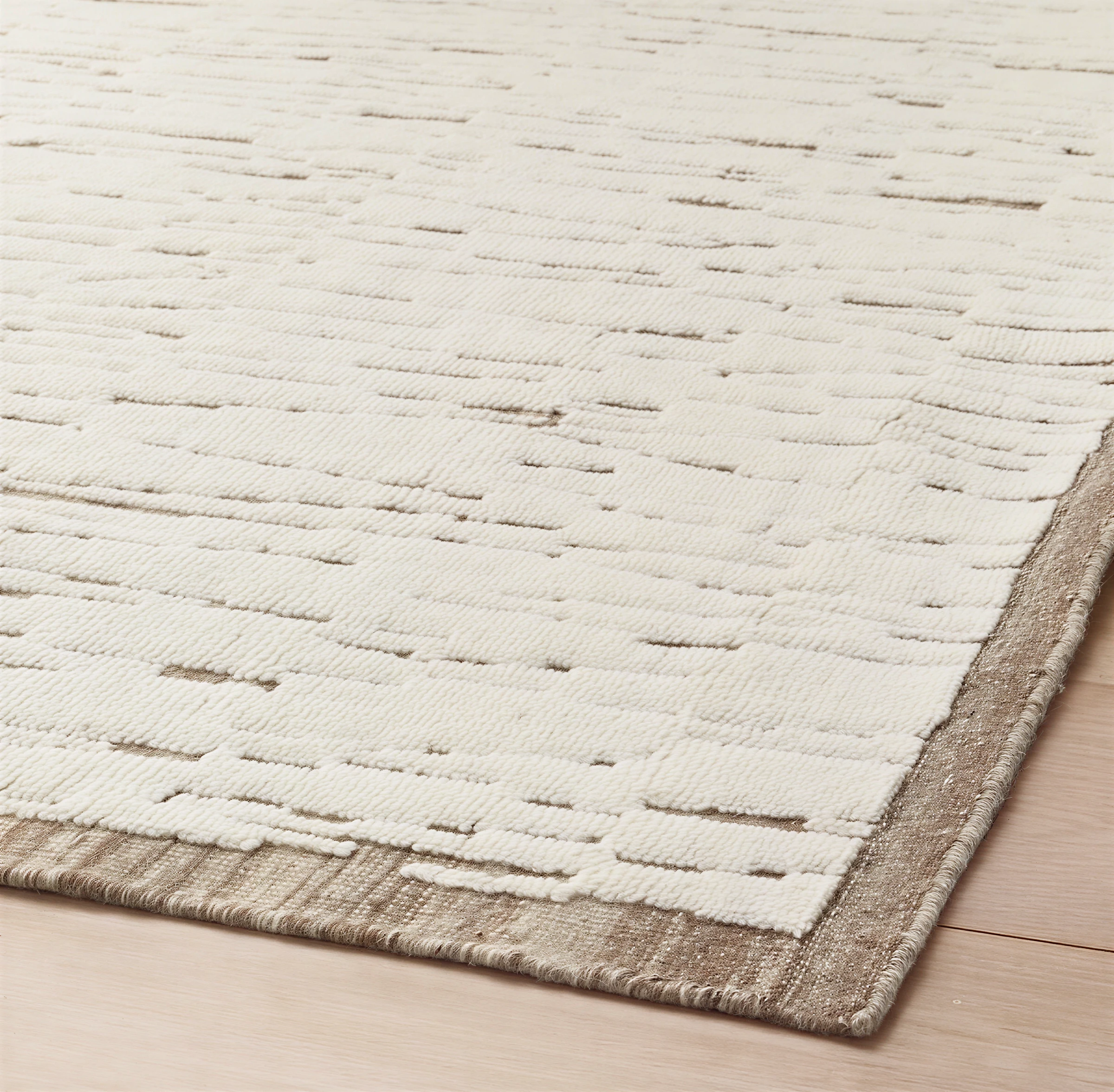
In a hand-knotted rug, every strand of pile yarn is individually tied around warp threads and locked in place by weft threads. The pile is not sitting on top of the structure — it is the structure. This is why hand-knotted rugs can be repaired almost indefinitely. Individual knots can be re-tied where wear has occurred. Fringe can be replaced. Borders can be rewoven. The rug is not a sealed unit but a living textile that skilled restorers can address at any level of granularity.
Do Rugs Appreciate in Value?
Fine handmade rugs have historically appreciated in value, though with significant variation depending on origin, age, condition, and market trends. Tribal and village rugs from the 19th and early 20th centuries have performed particularly well at auction, with exceptional pieces achieving multiples of their original retail value. Contemporary handmade rugs from respected makers are increasingly treated as collectible design objects in the same way that studio ceramics and original art have been.
Kapetto does not position its rugs as financial instruments — their value is in the living with them, not the speculating on them. But the broader point stands: a well-made handmade rug is unlikely to be worth nothing at the end of its working life. A machine-made rug almost certainly will be.
The Environmental Cost of Cheap Rugs
The environmental math of machine-made rugs is one of the least discussed aspects of the "worth it" question, and one of the most important.
Most machine-made rugs are produced from synthetic fibers: polypropylene, nylon, and polyester are the most common. These fibers are derived from petroleum, are not biodegradable, and shed microplastic particles throughout their working life. When the rug reaches end of life — which, as noted above, tends to be within a decade — it is almost universally landfilled. Global rug and carpet waste contributes billions of pounds to landfills annually.
A natural fiber handmade rug — wool, cashmere, jute, or silk — is biodegradable at end of life. It is made from renewable materials that have been grown in the natural carbon cycle. Its production uses significantly less energy than synthetic fiber manufacturing. And because it lasts decades rather than years, it represents a fraction of the material throughput of its machine-made equivalent over any given time horizon.
Kapetto's sustainability commitments extend across the supply chain: GoodWeave certification for ethical labor, OEKO-TEX Standard 100 for chemical safety, and a continuing investment in natural dye processes and closed-loop water systems in our partner workshops.
The Intangible Value
Numbers can establish the economic and environmental case for handmade rugs. They cannot capture the experience of living with one.
A hand-knotted or loom-knotted rug changes with time in the way that good wood furniture, aged leather, and well-made clothing change: it does not degrade, it develops. The high points of the pile catch light differently as it settles. The colors deepen slightly. The surface acquires a patina of use that, in a quality piece, reads as richness rather than wear. This is what rug collectors call "character" — and it is something that a machine, working at any speed or with any budget, cannot build in.
There is also the question of provenance. When you purchase a Kapetto cashmere rug or a hand-knotted wool piece, you are receiving an object made by specific people working in a specific place with a tradition going back centuries. The names of those artisans — Dablu, Rubina, Ayesha, Ram Sevak — are known to us. Their stories are part of the object. That connective thread between maker and owner is not sentimental decoration. It is the difference between a floor covering and a thing worth keeping.
Kapetto Pricing in Context
Kapetto's handmade rugs are priced to reflect honest production cost and sustainable margin. Our cashmere pieces start at prices that position them clearly in the luxury segment — this is intentional and accurate. Our wool and jute collections offer access to the same quality of construction and ethical sourcing at more accessible price points.
For designers working through the Kapetto Trade Program, trade pricing makes the cost-per-year calculation even more compelling. We encourage designers to present the full economic case to clients who hesitate at the initial number. Once the analysis is laid out, the conversation usually changes.
Handmade rugs are worth the investment. Not as an article of faith, but as a conclusion that follows from looking honestly at the numbers, the material science, the environmental ledger, and the quality of what you are actually bringing into a room. The only question is which handmade rug is the right one — and that is a much more interesting conversation to have.


