
When you purchase a GoodWeave certified rug, you are not simply buying a floor covering. You are participating in a system of accountability that connects your living room directly to the workshops of Bhadohi, Kathmandu, and the other rug-producing regions of South Asia — and in doing so, you are supporting a labor standard that matters. GoodWeave certified rugs are among the most rigorously audited products in the home furnishings industry. Understanding what that certification actually means — how it works, what it prevents, and why it matters — is essential knowledge for anyone who buys or specifies rugs with any degree of seriousness about where their products come from.
What GoodWeave Is
GoodWeave International is a nonprofit organization founded in 1994 by economist and human rights advocate Kailash Satyarthi, who later received the Nobel Peace Prize for his work on child labor. The organization operates a certification program specifically designed for the handmade rug industry — the sector that, prior to GoodWeave's founding, was among the most significant employers of child labor globally.
The certification system works by licensing rug exporters and importers who agree to comply with GoodWeave's labor standards, and then independently auditing their supply chains — including unannounced inspections at the workshop level — to verify compliance. Licensed companies pay a fee based on their export volume, which funds the inspection program, the rehabilitation programs for any children found in the supply chain, and GoodWeave's ongoing monitoring work.
The core promise of a GoodWeave label is straightforward: this rug was not made using child labor. But the certification system delivers considerably more than that single guarantee.
The Inspection Process: How It Actually Works
The credibility of any certification system rests entirely on the rigor of its inspection process. A certificate that is awarded once and never revisited is worth little. GoodWeave's value comes from a multi-layer audit structure that combines licensed exporter monitoring, supply chain mapping, and unannounced workshop inspections.
Exporter Licensing
Rug exporters and importers who wish to sell GoodWeave certified products must apply for a license and agree to a set of binding labor standards. These include prohibitions on child labor (defined as any worker under 14), minimum wage requirements for adult workers, legal working hours, and safe working conditions. Licensees must provide GoodWeave with a full map of their supply chain — every subcontractor, every workshop, every step between raw fiber and finished rug.
Unannounced Workshop Inspections
GoodWeave employs a network of trained inspectors who conduct unannounced visits to workshops throughout the licensed supply chain. These visits happen at irregular intervals and without prior notice, specifically to prevent any staging of conditions. Inspectors verify the ages of workers (which may require checking identity documents or using medical estimation where documents are unavailable), assess working conditions against GoodWeave's standards, and interview workers about their employment terms and conditions.
The unannounced character of these inspections is what distinguishes GoodWeave from certification systems that allow pre-scheduled audits, where conditions can be prepared in advance. Randomness is built into the inspection methodology as an anti-corruption measure.
Supply Chain Traceability
Because rug production frequently involves multiple workshops — spinning, dyeing, weaving, and finishing may all happen in different locations — GoodWeave requires traceability at each step. A GoodWeave certified rug carries a unique code that traces it through the production chain. This allows any rug to be connected to the specific workshops involved in its production, which in turn allows inspection resources to be targeted appropriately and any problems identified to be traced to their source.
Child Labor Prevention: The Heart of the Program
The handmade rug industry's historical problem with child labor was not incidental — it was structural. Children were employed because they were cheaper than adults, because their small fingers could work in tight spaces on fine patterns, and because in many producing communities, sending children to workshops was considered a normal part of family economic life. Changing this required not just inspection and enforcement but the creation of economic and social alternatives.
When GoodWeave inspectors find a child working in a licensed workshop, the response is not punitive withdrawal of the license. It is intervention: the child is removed from the workshop, provided with remedial education, and their family is connected with support services that address the economic pressures that drove the family to send their child to work in the first place. The workshop is put on a remediation plan, with follow-up inspections to verify compliance. The goal is rehabilitation of the supply chain, not simply exposure of the problem.
This combination of detection, rescue, education, and economic support is what distinguishes GoodWeave from simpler "we inspect for child labor" claims. The organization's education programs have supported thousands of children who were found in or at risk of entering rug production workshops, giving them access to schooling that was often not previously available to them.
Adult Worker Standards: Beyond Child Labor
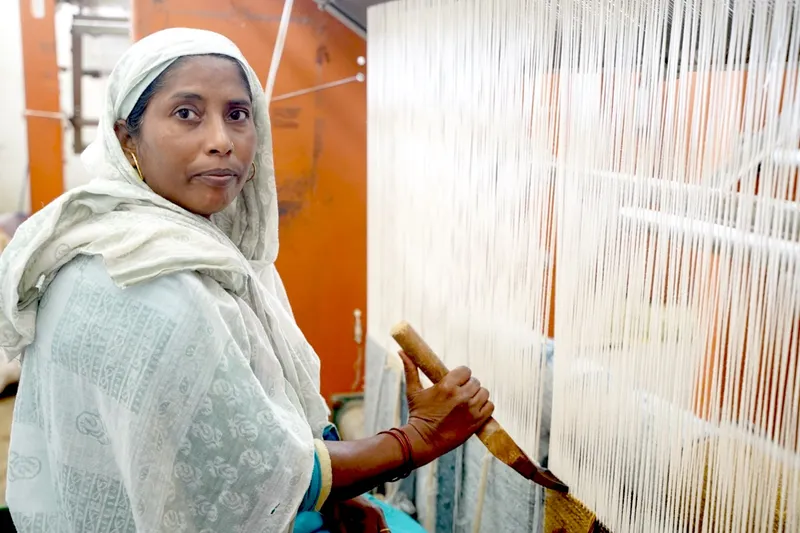
GoodWeave's scope has expanded significantly since its founding. While child labor prevention remains the certification's defining purpose, GoodWeave's current standards also address the working conditions of adult weavers: wage levels, working hours, workspace safety, and the right to organize. For a craft sector where adult workers — particularly women working in home-based weaving arrangements — are vulnerable to wage exploitation and unsafe conditions, these expanded standards are significant.
GoodWeave requires that adult workers in licensed supply chains earn at least the legal minimum wage for their region, that working hours comply with local labor law, and that workspaces meet basic safety requirements. Inspectors assess these conditions during their unannounced visits and document any non-compliance for remediation.
How to Verify a GoodWeave Certification
Every rug bearing the GoodWeave label carries a unique certification code. This code can be verified at GoodWeave's website, where the certification database is publicly accessible. Entering the code confirms that the rug was produced within a licensed supply chain and is covered by GoodWeave's monitoring program. This verification step is available to any buyer, designer, or consumer — the transparency of the system is one of its core features.
For designers and architects specifying rugs for client projects, GoodWeave verification provides a documentable response to clients who ask about the social provenance of their purchases. In an era when high-end clients increasingly care about where their luxury goods come from, the ability to reference an independently verified certification — with a public verification link — is a practical professional asset.
Why GoodWeave Matters for Interior Designers
The luxury market's relationship with ethical sourcing has changed significantly over the past decade. What was once a niche concern is now a mainstream expectation among a significant portion of high-net-worth consumers, particularly those commissioning residential interiors at the level where handmade rugs are specified. Designers who can speak fluently about the certifications behind their specified products are responding to a real client need.
GoodWeave certification provides something that marketing language cannot: independent verification. A brand can describe its sourcing practices in any terms it chooses without anyone checking. A GoodWeave certified rug has been inspected by people who are independent of the brand and whose job is specifically to find problems. That independence is what makes the label meaningful.
For specification purposes, the GoodWeave certification also integrates naturally into broader sustainability documentation for LEED, WELL, or other green building frameworks where supply chain transparency and ethical labor sourcing can contribute to certification points or narrative credits.

Kapetto's Certifications
All of Kapetto's production partners are GoodWeave licensed facilities. This means that every rug in the Kapetto collection — from the Cashmere Caramel to the Kiri hand-knotted to the Sabi Natural — is produced under conditions that have been independently verified against GoodWeave's labor standards, with ongoing unannounced inspections.
GoodWeave is one of several certifications that Kapetto's supply chain carries. OEKO-TEX certification addresses the chemical safety of the finished textile — ensuring that no harmful substances are present in the fiber, dye, or finishing materials at levels that could affect health. ISO 9001 certification covers quality management systems, ensuring that the production processes meet documented standards consistently across batches. Together, these certifications address labor, environmental, chemical, and quality dimensions of responsible production.
The full set of Kapetto's certifications, with verification details, is available on the Sustainability page. For designers working on projects where certifications need to be documented for client approval or green building frameworks, the Kapetto Trade Program provides access to certification documentation and letters of compliance.
A GoodWeave label is not a marketing claim. It is a commitment that has been tested, and verified, by people whose job is to find the truth.
The Larger Significance
Purchasing a GoodWeave certified rug is an act that extends well beyond the transaction. Every licensed sale funds the inspection program that protects the next child who might otherwise end up at a loom instead of in a school. The economics of certification are self-reinforcing: the more demand there is for GoodWeave certified rugs, the more resources are available for inspections, for education programs, and for the economic development initiatives that address the root causes of child labor in producing communities.
Kapetto's commitment to GoodWeave is not merely a compliance posture. It is an expression of a belief that the beauty of a handmade rug is inseparable from the integrity of how it was made. A rug that carries a story of exploitation, however beautiful, is compromised. A rug that carries a story of skilled, fairly compensated adult craftsmanship — inspected, verified, and supported — is something you can live with, in every sense.
Explore the artisans who make Kapetto's rugs at Our Artisans, or learn more about the full range of ethical and environmental commitments behind the brand at Sustainability. The Cashmere, Wool, and Jute collections are all produced within GoodWeave licensed supply chains.


