

Custom rugs and bespoke handmade pieces are among the most rewarding commissions in residential design, and among the most misunderstood. Designers who have never commissioned a handmade rug from scratch often approach the process with uncertainty: How does it work? How long does it take? How is pricing structured? What happens if the sample is wrong? This guide answers those questions plainly, using Kapetto's custom program as the practical framework.
The short version: commissioning a custom rug requires time, patience, and clarity of intention. It rewards all three with a piece that fits your room, your project, and your client's life with a precision that no stock piece ever quite achieves.
When Custom Is the Right Choice
Standard rug sizes — 5-by-7, 6-by-9, 8-by-10, 9-by-12 — work well for most residential applications. Before committing to a custom commission, confirm that none of the available standard sizes will serve the room. Custom production adds both cost and lead time, and the right standard size in the right colorway often produces an excellent result.
Custom becomes genuinely necessary in several situations. Rooms with non-standard proportions — long, narrow galleries, irregular floor plans, or spaces with fixed furniture that constrains the area available for a rug — often require dimensions that no standard range covers. Hospitality projects frequently require sizes that scale to very large footprints: 12-by-18 or 14-by-20 foot pieces are not uncommon in hotel lobbies or large-scale residential living rooms. Round and oval shapes almost always require custom production. And custom colorways — a specific tone matched to a client's existing upholstery or a proprietary palette developed for a hospitality brand — require the full custom process regardless of the size needed.
The Custom Process: From Consultation to Delivery
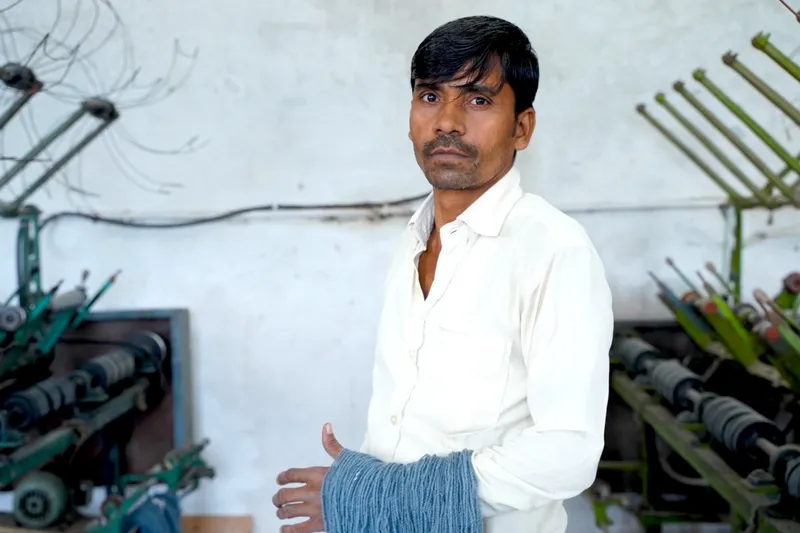
Commissioning a bespoke rug through Kapetto follows a structured process that has been refined through years of trade and hospitality work. Understanding each stage helps set realistic expectations and prevents the misalignments that cause delays and disappointment.
Stage 1: Consultation
Every custom commission begins with a detailed consultation. For trade clients working through our Kapetto Trade Program, this typically happens via email, video call, or through our dedicated trade team. The consultation covers the essential parameters of the commission: the intended room and its dimensions, the desired rug size and shape, the material preference (cashmere, wool, or jute), the pile height requirement, the colorway direction, and any pattern or design elements the client wants to introduce or reference.
At this stage, it is also important to discuss traffic levels, maintenance expectations, and budget. A hand-knotted Kiri wool rug at 100 KPSI is the right choice for a room where exceptional durability and long-term value are priorities; a cashmere piece is right where luxurious softness and quiet refinement are the primary brief. The consultation helps us guide that decision with knowledge of how each material and construction performs in real-world conditions.
Stage 2: Design and Specification
Following the consultation, Kapetto prepares a formal specification document covering the agreed dimensions, shape, material, construction, pile height, colorway, and any design details. This document forms the basis of the commission agreement and the production brief sent to our Bhadohi workshops.
For commissions involving a custom colorway, we send physical yarn samples at this stage. Color matching from digital references is never precise enough for a final commitment — the way a dye reads on natural wool or cashmere under residential lighting can differ significantly from how it reads on a screen or even on a printed swatch. Physical yarn samples allow you and your client to make an informed decision before production begins.
For commissions involving a non-standard design or pattern, a scaled design drawing or digital mockup is prepared and approved before the brief is sent to the loom. Changes to design or color after production begins are not possible without starting the piece over, so this approval stage is genuinely critical.
Stage 3: Sampling
For significant commissions — particularly those involving a new colorway or a design that has not been produced before — a sample section may be produced before the full piece is committed. A sample typically covers a 12-by-12 or 18-by-18 inch section of the rug in its actual construction, colorway, and pile specification. This allows you to verify that the physical execution matches the specification before the full production investment is made.
Sample production adds two to four weeks to the overall timeline but is almost always worth it for large commissions or for clients who have not worked with handmade rugs before and find it difficult to visualize the final result from yarn samples alone.
Stage 4: Production
Once the commission is approved and the deposit received, production begins at the Bhadohi workshop. The warp is set, the design is transferred to the loom as a full-scale cartoon, and the artisans begin knotting. For a 9-by-12 foot hand-knotted rug at 100 KPSI, this means approximately 1.5 million individual knots tied over the course of four to five months.
During production, we provide periodic progress updates at agreed intervals. For very large commissions or for clients who want greater visibility into the process, photographic updates from the loom are available.
Stage 5: Finishing and Quality Inspection
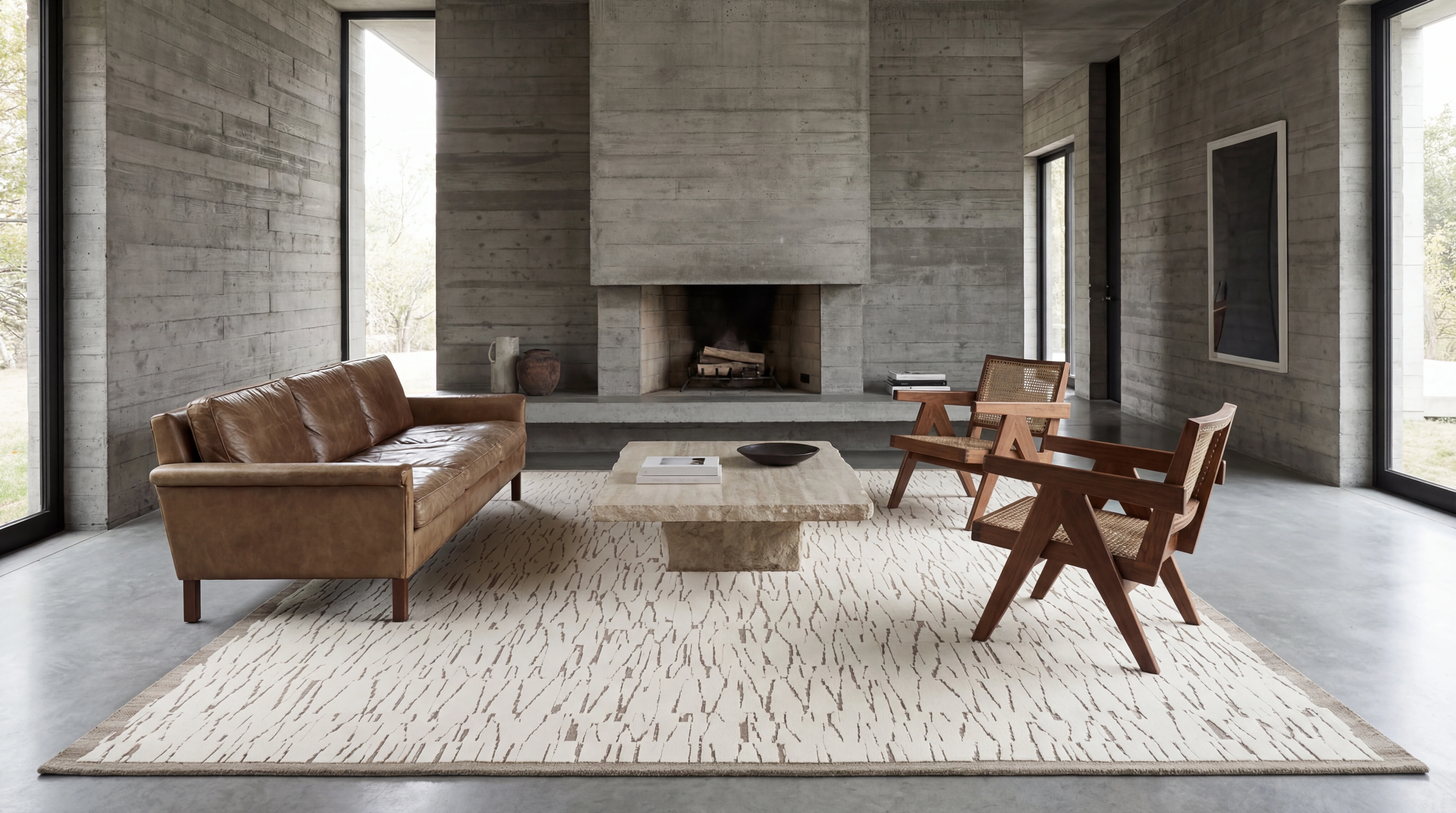
When the knotting is complete, the rug is cut from the loom and goes through a series of finishing processes: clipping the pile to an even height, washing to remove any lanolin residue and set the dyes, and stretching and drying flat to ensure the piece lies true. A final quality inspection covers pile evenness, color consistency, dimensional accuracy, and foundation integrity. Any piece that does not meet specification is returned for correction before shipping.
Stage 6: Delivery
Custom commissions are shipped rolled, not folded, in protective packaging. For US deliveries, we work with freight partners who handle fragile high-value shipments with appropriate care. Delivery to most US destinations takes one to two weeks following dispatch from Bhadohi.
Pricing: Understanding Per Square Foot Rates
Custom rug pricing is calculated on a per square foot basis, which makes it straightforward to estimate costs for any size. Kapetto's custom pricing reflects the material and construction of the piece:
- Cashmere: from $55 per square foot
- Kiri hand-knotted wool: from $60 per square foot
- Nami wool: from $42 per square foot
- Yuka flat-weave wool: from $37 per square foot
- Sabi jute: from $20 per square foot
Custom sizing carries a 20% premium over the equivalent standard size price, reflecting the additional workshop setup, the design translation cost, and the higher relative labor intensity of non-standard dimensions. For hospitality projects with significant volume, trade pricing is available through the Kapetto Trade Program.
A deposit of 50% is required to begin production, with the balance due prior to shipping.
Lead Times: What to Expect
Honest lead time management is one of the most important services a rug supplier can provide. Handmade rugs cannot be rushed without compromising quality, and the consequences of an optimistic lead time promise on a major project can be severe.
At Kapetto, standard custom commissions have the following lead times:
- Regular production: 28 to 30 weeks from commission approval
- Expedited production: 23 weeks from commission approval (20% surcharge on custom price)
These timelines include design approval, sampling (if required), production, finishing, quality inspection, and shipping. They do not include time taken by the client to review and approve yarn samples or design documents — the clock begins when we have a fully approved brief and a deposit in hand.
For project managers working to a hard installation date, we recommend building an additional two to four weeks of buffer into the schedule to account for any finishing adjustments or shipping delays. Starting the custom process at least eight months before a desired installation date is prudent for hand-knotted pieces.
Shapes: Beyond the Rectangle
Standard rug shapes — rectangular pieces in standard proportions — are the most efficient to produce and the most versatile to use. But custom commissions open the full range of shapes:
Rectangular custom dimensions. Any length-to-width ratio within practical loom limits. Useful for long narrow corridors, unusually proportioned rooms, or spaces where a standard ratio simply does not fit the floor plan.
Square. Increasingly popular in dining rooms and in open-plan spaces where a square rug anchors a seating group more evenly than a rectangle. Custom square commissions are straightforward for all constructions.
Round. Round rugs require a different production process — the piece is typically woven as a square and then cut and bound in a circular shape. This adds some finishing complexity and cost, but the result is a piece that works beautifully under circular dining tables, in entry vestibules, or as a defined accent in a bedroom.
Oval. Similar in production terms to round, oval rugs are a classic shape with a softer, more traditional character. They work particularly well in formal dining rooms and in bedrooms with four-poster or canopy beds.
Irregular and freeform. For truly bespoke architectural applications, irregular shapes can be produced with the commission brief. These require detailed design drawings and add to the finishing and binding complexity, but they can solve problems that no standard shape addresses.
Working with Kapetto's Custom Program
Our custom program is designed with the working designer in mind. We understand that custom commissions are high-stakes, time-sensitive, and require a supplier who is genuinely responsive at every stage. Trade clients working through the Kapetto Trade Program have access to dedicated support, priority sampling, and the kind of direct communication with our production team that makes complex projects manageable.
For homeowners commissioning a custom piece directly, we bring the same transparency and care to every stage of the process. A custom rug is a significant decision and a meaningful investment. It deserves to be made exactly right.
To begin a custom commission, reach out through our trade page or contact form. Include the intended room dimensions, your material preference, and any inspiration images or palette references that capture the direction you have in mind. We will respond with a consultation proposal and begin the process of making exactly the right piece for your project.
The result of a well-executed custom commission is a rug that belongs in your room in a way that no stock piece ever quite manages. It fits. It is exactly the color it needed to be. It fills the space with the authority that only a piece made specifically for it can carry. For the rooms that matter most, that specificity is worth every week of the wait.


