

There is a city in the Gangetic plain of Uttar Pradesh where the air carries the faint smell of natural dye, where the rhythmic clack of looms drifts from workshops tucked behind ochre walls, and where a ten-year-old child can already name a dozen knot types by touch. That city is Bhadohi, and for five centuries it has supplied the world's finest rooms with handmade rugs India is rightly famous for. When people speak of Bhadohi rugs, they are invoking a living tradition that predates the Mughal empire's height, one that has survived colonization, mechanization, and the relentless churn of global fashion.
Kapetto was founded here, not as a romantic gesture toward heritage, but because nowhere else on earth offers the same concentration of skill, material knowledge, and generational craft. Understanding Bhadohi is understanding what makes a truly great rug possible.
How Bhadohi Became the Carpet Capital of the World
The region's association with rug making is typically traced to the sixteenth century, when Mughal emperor Akbar established imperial workshops across northern India, importing Persian master weavers to teach local craftspeople the art of fine knotting. The Gangetic plain offered conditions that proved ideal: abundant water for dyeing, a climate that kept natural fibers supple, and a large agrarian population with the patience that fine weaving demands.
By the nineteenth century, Bhadohi and the surrounding district — which includes Mirzapur and Varanasi — had become the dominant rug-producing region in Asia. British trading companies catalogued the area's output with admiration; American department stores placed bulk orders through agents who traveled annually to the workshops. The term "carpet capital of the world" was not coined by a marketing department. It emerged from the trade data: this small corridor of eastern India accounted for, at its peak, over 90 percent of India's rug exports.
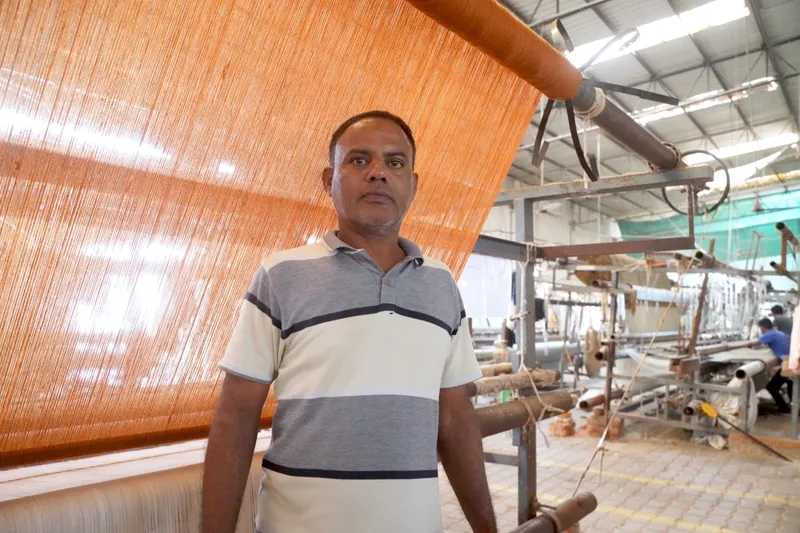
Today, Bhadohi remains the undisputed center of handmade rug production in India. The district employs an estimated two million people across every stage of the supply chain: spinners, dyers, weavers, carvers, washers, stretchers, and quality inspectors. It is a fully integrated ecosystem where each specialist passes their piece to the next, like a relay of skilled hands, until a finished rug emerges.
The GI Tag: Official Recognition of an Ancient Craft
In 2010, the Geographical Indication Registry of India granted Bhadohi a GI tag for its handmade carpet production — the equivalent of Champagne's appellation or Parmigiano-Reggiano's protected designation. The GI tag legally recognizes that the qualities of Bhadohi rugs are inseparable from the place and people that produce them. You cannot make an authentic Bhadohi rug in a factory in Guangzhou or a warehouse in Lahore. The craft belongs to this geography, to these families, to this accumulated knowledge.
The GI tag also created a framework for quality standards. Registered producers must adhere to specific construction techniques, material sourcing practices, and finishing methods. This protects both the buyers who invest in Bhadohi rugs and the artisans who depend on the reputation of the designation for their livelihoods.
The Weaving Ecosystem: A City Built Around a Single Craft
What distinguishes Bhadohi from other rug-producing regions is not simply its scale, but its integration. The city is not a factory district; it is a craft civilization. Walk through any neighborhood and you encounter different specialists within a few hundred meters of each other.
The yarn markets operate every morning before dawn, where merchants sell raw wool from New Zealand and Australia, cashmere from the highlands of Central Asia, and local cotton for warp threads. The quality conversation happens here, between buyers who can assess fiber length and crimp by feel alone.
The dye houses are often family-run operations that have refined their recipes across generations. Natural dyes — indigo, pomegranate rind, madder root, walnut shell — are still used by the most skilled practitioners, each producing colors that deepen rather than fade with age. Synthetic dyes, when used by reputable producers, are OEKO-TEX certified, ensuring no harmful chemicals enter the water table or the final product.
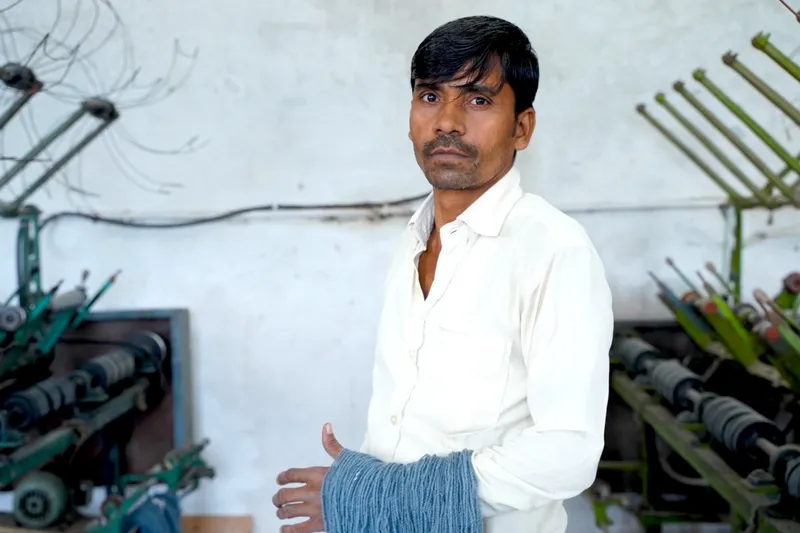
The weaving households are the heart of it all. Many operate traditional pit looms, where the weaver sits in a shallow excavation below the loom frame, giving them access to the full width of a wide rug. Others use standing frame looms for smaller pieces. In either case, the work is the same: individual knots, tied by hand, row by row, over weeks and months.
The finishing yards handle washing, stretching, carving, and clipping. After a rug comes off the loom, it is washed in the Ganges tributaries that flow nearby, then stretched on outdoor frames to dry flat. Carvers use specialized scissors to sculpt the pile, accentuating patterns and giving the surface its final texture. It is painstaking work that can add days to the production of a single piece.
Bhadohi Today: Challenges and Resilience
The past three decades have not been entirely smooth for Bhadohi. The rise of machine-made rugs from China and Turkey, priced at a fraction of the handmade alternative, forced many smaller producers to compete on price alone — a race that erodes quality and ultimately undermines the value of the craft. The COVID-19 pandemic disrupted supply chains and forced many artisan families into acute hardship when export orders evaporated overnight.
But Bhadohi is resilient precisely because it is a living ecosystem rather than a single factory. The knowledge is distributed across thousands of households. It cannot be outsourced. It cannot be automated. And there is a growing counter-movement: buyers in the United States and Europe who have tired of disposable rugs are specifically seeking out Bhadohi provenance, willing to invest in pieces that will outlast them.
Kapetto's Direct Relationship with Bhadohi
Kapetto was built on a single conviction: that the value of a Bhadohi rug should flow back to the people who created it. The conventional rug trade operates through layers of intermediaries — exporters, importers, wholesalers, distributors — each taking a margin that compresses what artisans can actually earn. Kapetto works differently.
We maintain direct relationships with specific artisan families and workshops in Bhadohi. Our design team works in the city, not from a remote studio. Quality approvals happen on site, in the finishing yard, before a rug leaves. When you purchase a Kapetto rug, you can see the face of the person who made it and know something about the workshop where it was created.
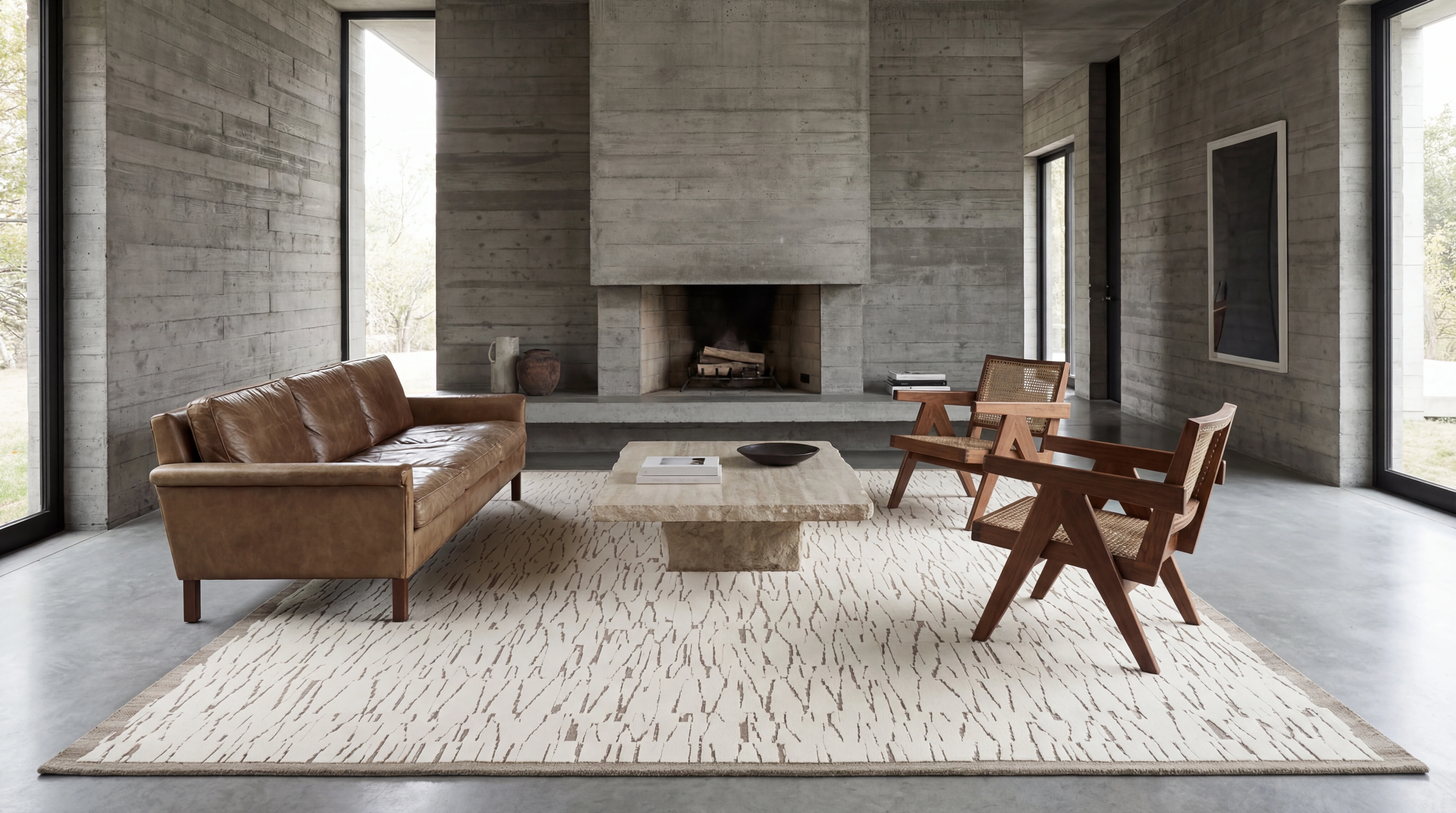
This directness has practical benefits for quality. Without intermediaries pressuring workshops to cut corners and shorten timelines, artisans can do the work properly. The Cashmere collection, for example, requires a 15mm pile height that demands precise clipping and finishing — work that takes time and cannot be rushed without visible consequence. Our artisans have that time because our model gives it to them.
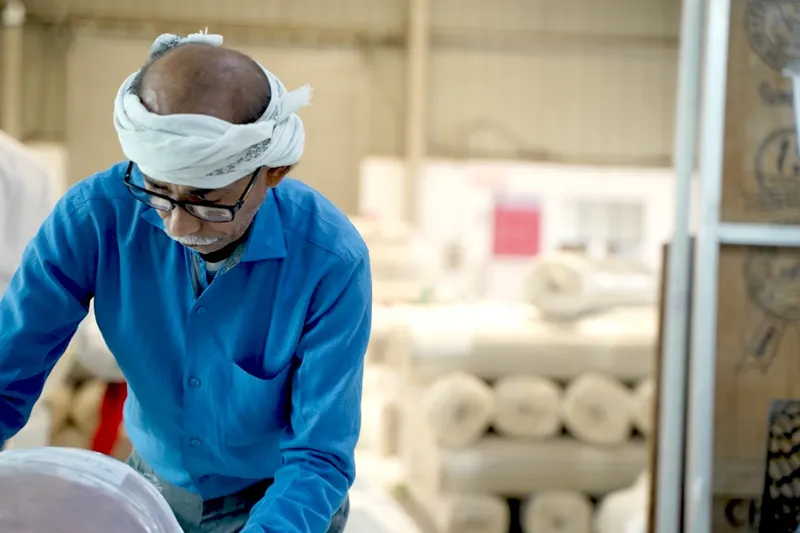
We are also committed to sustainable sourcing practices that respect both the artisans and the environment. Our workshops hold GoodWeave certification, ensuring no child labor in the supply chain. OEKO-TEX certification covers every dye lot we use. These are not marketing claims — they are audited annually by third-party organizations that visit Bhadohi in person.
Why Provenance Matters When Buying Handmade Rugs
The global rug market is opaque. A rug described as "handmade" might mean anything from genuinely hand-knotted by a skilled artisan to hand-tufted by a production-line worker using a mechanical tufting gun. A rug described as "Indian" might have been assembled in a factory from components produced in three different countries. Provenance — specific, verifiable provenance — is the only reliable protection against this ambiguity.
Bhadohi provenance means something precise. It means the rug was made within a tradition that has its own techniques, its own quality standards, and its own community of knowledge holders. It means there are people in that city whose grandparents made rugs and whose grandchildren will make rugs, and who understand their craft at a depth no instruction manual can convey.
When you look at a Kapetto rug, you are looking at Bhadohi. The city is in the knots.
Frequently Asked Questions About Bhadohi Rugs
What makes Bhadohi rugs different from other Indian rugs?
Bhadohi sits within the largest concentration of hand-knotting expertise in the world. The region has a GI tag protecting its production methods, a fully integrated supply chain from raw fiber to finished piece, and a multigenerational culture of weaving that produces a distinctive quality of construction and finish. Other Indian regions produce excellent rugs, but the depth and specialization of Bhadohi's ecosystem is unmatched.
How can I verify that a rug is genuinely from Bhadohi?
Ask for specific workshop information: the name of the producing workshop, its location within the district, and its certifications. Reputable brands like Kapetto can provide artisan profiles and workshop details for every piece. Generic claims of "made in India" without supporting documentation should prompt further questions.
Are Bhadohi rugs good quality?
The best Bhadohi rugs rank among the finest handmade rugs produced anywhere in the world. The region's concentration of skilled artisans, combined with access to premium materials and centuries of refined technique, makes exceptional quality achievable at price points below what equivalent Persian or Tibetan pieces would cost. Quality varies across producers, which is why choosing a brand with transparent supply chain relationships matters.
How long do handmade rugs from Bhadohi last?
A well-made, properly cared for Bhadohi hand-knotted rug will last 50 to 100 years or more. Wool's natural resilience and the density of fine knotting create a structure that actually improves with light use, developing a patina that machine-made rugs cannot replicate. The oldest pieces from this region still in use are over two hundred years old.


